
Most real estate agents in Pakistan are working with the same system they used years ago.
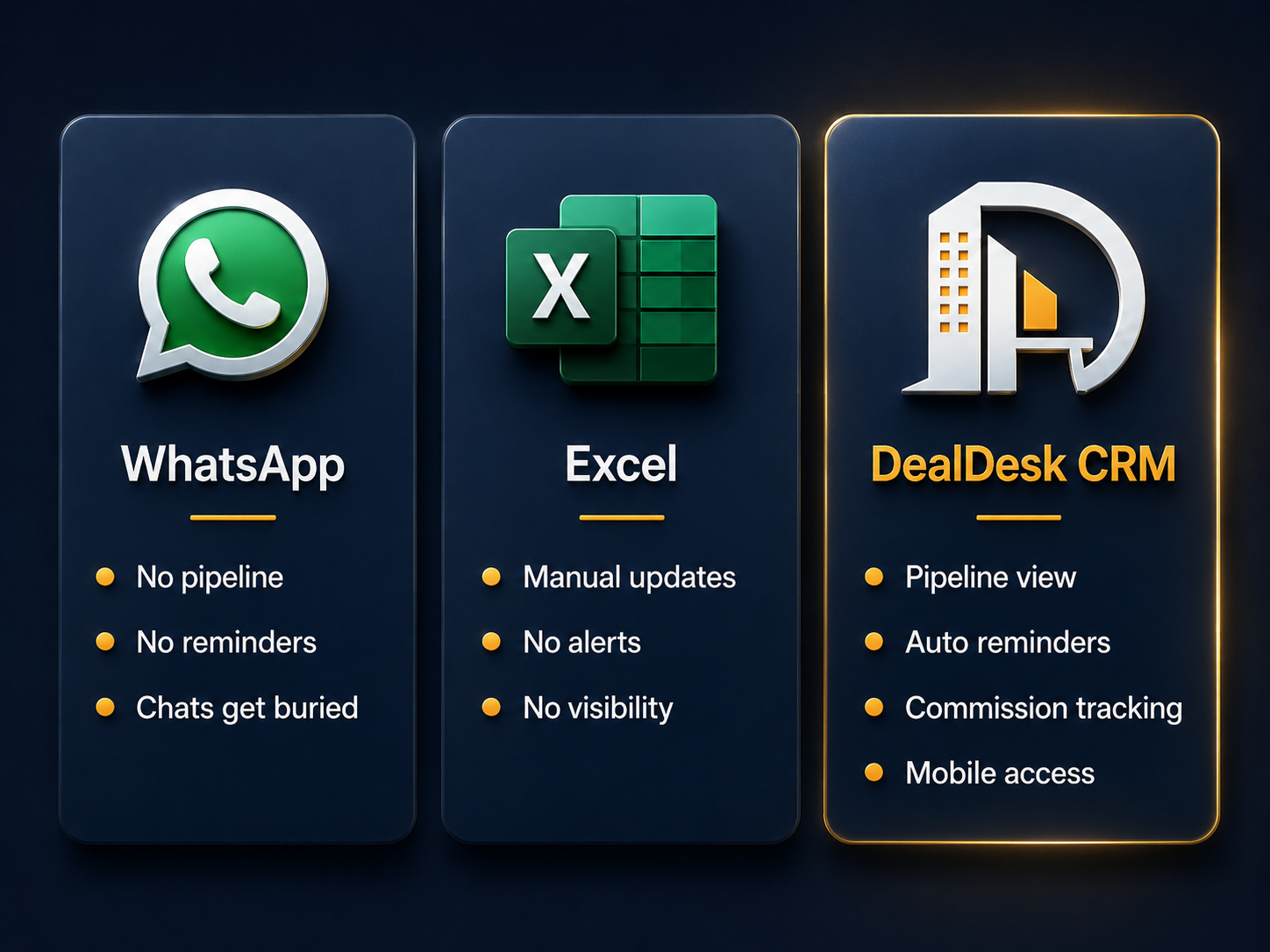
Client numbers are stored in Excel sheets. Property details are written manually. Follow-ups are remembered mentally. Conversations happen across WhatsApp calls and chats.
At first, this feels manageable.
But as the business grows, the cracks start to appear.
Leads get lost. Follow-ups are missed. Important client details disappear in long spreadsheets. And despite working all day, many agents still struggle to close deals consistently.
The issue is not effort.
The issue is the system.
Why Excel became the default tool
For many agents, Excel feels simple and familiar.
It allows you to:
- Store client information
- Keep records of properties
- Organize basic data
And for a small number of leads, it can work temporarily.
But real estate businesses do not stay static for long.
As inquiries increase and multiple deals move simultaneously, Excel starts creating more confusion than clarity.
Because real estate is not just data management.
It is relationship management, deal tracking, follow-ups, communication, and timing.
And Excel was never built for that.
The real problems with managing real estate on Excel
The biggest problem is that Excel only stores information. It does not help you manage workflows.
You may have hundreds of rows filled with client names and numbers, but you still do not know:
- Which client needs follow-up today
- Which deal is stuck
- Which property was shared with whom
- Which leads are active or inactive
- Which deals are close to closing
As a result, agents constantly shift between spreadsheets, WhatsApp chats, notes, and calls just to understand what is happening.
This creates daily chaos.
And eventually, opportunities start slipping away silently.
Why this becomes expensive over time
Many agents underestimate how much poor organization costs them.
A missed follow-up may seem small, but it can result in a lost deal.
A delayed response can push a client toward another agent.
A forgotten requirement can damage trust instantly.
When this happens repeatedly, the financial impact becomes serious.
The frustrating part is that most agents never realize where the problem actually is.
They believe they need more leads, while the real issue is poor lead management.
The mindset shift real estate agents need
The goal is not to work harder.
The goal is to work with structure.
Successful real estate businesses are not built on memory and scattered tools. They are built on systems that create visibility and consistency.
This is where a CRM changes everything.
What a CRM does differently
A CRM is designed specifically to manage client relationships and workflows.
Instead of scattered information, everything is centralized in one place.
With a CRM, you can:
- Manage all leads and clients from one dashboard
- Track every deal through clear stages
- Schedule follow-ups automatically
- Record property preferences and interactions
- Monitor deal progress in real time
Instead of reacting randomly throughout the day, you begin operating with clarity.
You always know:
- Who needs attention
- What stage each deal is in
- What the next action should be
That visibility is what improves performance.
CRM vs Excel: the real difference
Excel helps you store data.
A CRM helps you manage a business.
That difference is critical.
Excel is static. A CRM is dynamic.
Excel depends on manual effort. A CRM creates workflows.
Excel shows information. A CRM helps you take action.
In real estate, action and timing are what close deals.
Where DealDesk fits into this
This is where platforms like DealDesk become valuable.
Instead of managing leads, properties, follow-ups, and commissions separately, DealDesk brings everything into one organized system.
It helps agents:
- Track clients properly
- Manage deals visually
- Set structured follow-ups
- Share properties efficiently
- Monitor commissions clearly
The purpose is not just organization.
It is creating a workflow that helps agents close more deals with less confusion.
Practical takeaways
If you are still managing your business on Excel alone, start improving your process with these steps:
- Centralize all client and property data
- Stop relying on memory for follow-ups
- Use a deal pipeline to track progress
- Keep communication and records organized
- Build systems that can scale with your business
Final thought
The real estate market in Pakistan is becoming more competitive every year.
Agents who continue using manual systems will eventually struggle to keep up with those using structured workflows and modern tools.
Growth today is not about staying busy.
It is about staying organized.
Because the agents who manage their clients, follow-ups, and deals more effectively are the ones who consistently close more business.
And if you are serious about scaling your real estate operations, moving beyond Excel may be one of the most important decisions you make.