

Most real estate agents believe the biggest challenge in business is getting more leads.
But in many cases, the real problem starts after the lead arrives.
You receive an inquiry. The client asks for details. You share a few property options and promise to follow up later.
Then the conversation slows down.
A few days pass, and suddenly the client is no longer responding.
Eventually, you find out they closed the deal with another agent.
This situation is extremely common in real estate.
And most of the time, it has nothing to do with pricing, listings, or effort.
It happens because the lead was not managed properly.
Why real estate leads get lost
Most agents do not intentionally ignore their clients.
The issue is usually the system they are working with.
In many real estate businesses, lead management looks like this:
- Conversations scattered across WhatsApp
- Client details stored in notebooks or Excel sheets
- Follow-ups remembered mentally
- No visibility into deal progress
- No structured process for managing inquiries
At a small scale, this may seem manageable.
But once multiple leads start coming in every day, things quickly become difficult to control.
Conversations overlap. Follow-ups are missed. Client preferences are forgotten.
And slowly, opportunities begin disappearing without anyone realizing where the problem started.
The biggest mistake agents make
Many agents focus entirely on generating new leads.
They spend money on ads, marketing campaigns, and promotions hoping more inquiries will increase sales.
But more leads inside a disorganized system do not solve the problem.
They increase confusion.
Because if your current process cannot handle 20 leads properly, it will struggle even more with 100.
The issue is rarely lead quantity.
The issue is lead management.
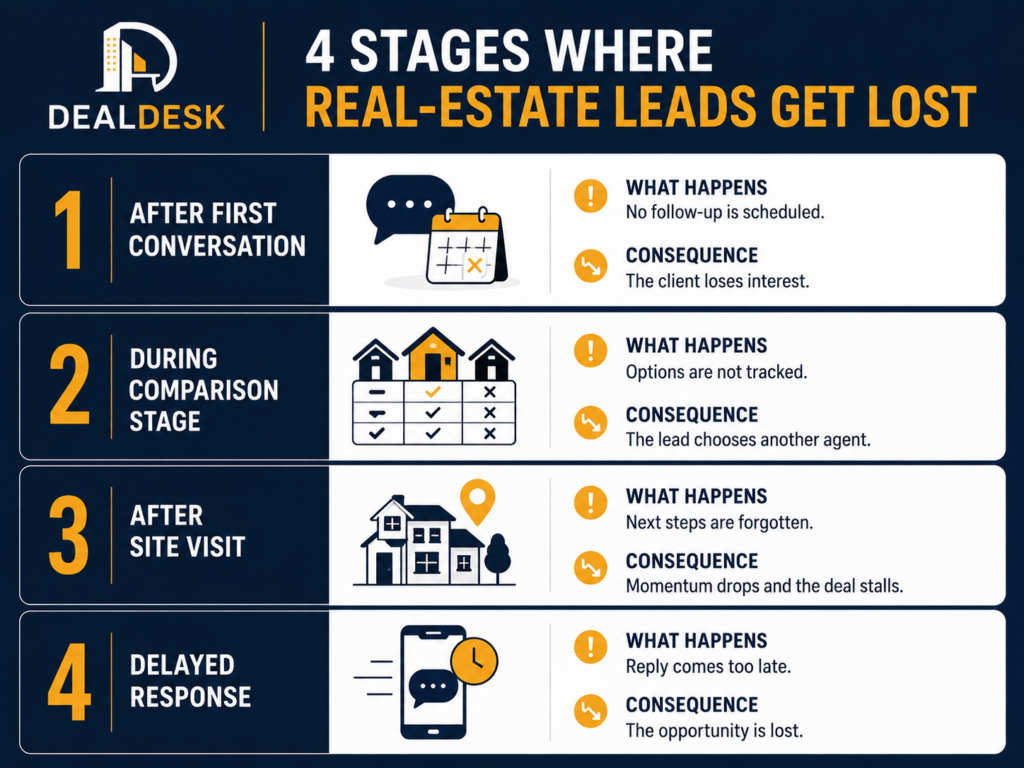
Where most leads are actually lost
Real estate leads are usually lost at predictable stages.
After the first inquiry
Many agents assume the client will reconnect later.
But without a timely follow-up, the conversation fades quickly.
The client moves toward the agent who stays visible and responsive.
During comparison
Clients often speak with multiple property dealers before making a decision.
At this stage, consistency matters more than anything.
The agent who follows up regularly and provides organized communication builds more trust.
After property visits
This is one of the most critical moments.
Clients often say they will “think about it” after a visit.
Without a structured follow-up process, interest fades and the deal disappears silently.
Due to delayed responses
In competitive markets, response time matters.
Even a small delay can shift the client toward another agent who replied faster and stayed engaged.
Why this becomes expensive
Every missed follow-up has a financial cost.
If you receive dozens of inquiries every month and lose even a small percentage due to poor organization, the impact becomes significant.
The frustrating part is that most agents cannot identify exactly where deals are being lost.
There is no tracking system, no visibility, and no structured workflow.
Everything depends on memory and scattered conversations.
The shift real estate businesses need
The solution is not working longer hours.
The solution is building a proper system.
Successful real estate businesses manage leads systematically instead of reacting randomly throughout the day.
This means:
- Tracking every inquiry
- Organizing all client information
- Managing follow-ups consistently
- Monitoring deal stages clearly
This is where a real estate CRM becomes essential.
How a CRM helps manage real estate leads
A real estate CRM helps agents centralize and organize their entire workflow.
Instead of relying on WhatsApp chats and spreadsheets, everything is managed from one system.
With a CRM, you can:
- Track every lead from inquiry to closing
- Schedule follow-ups automatically
- Organize client requirements properly
- Monitor active and inactive deals
- Maintain visibility over your sales pipeline
This improves consistency, response time, and overall deal management.
Most importantly, it reduces the number of leads that disappear silently due to poor tracking.

Where DealDesk fits into this
Platforms like DealDesk are designed specifically to help property dealers manage leads more efficiently.
Instead of juggling conversations, spreadsheets, and manual notes, DealDesk helps agents organize everything in one place.
It allows you to:
- Manage all clients centrally
- Track deal stages visually
- Set structured follow-up reminders
- Share properties professionally
- Keep records organized and accessible
The goal is not simply to store data.
The goal is to create a workflow that helps you close more deals consistently.
Practical takeaways
If you want to stop losing real estate leads, start with these steps:
- Bring all lead information into one system
- Stop relying on memory for follow-ups
- Track every deal stage clearly
- Respond quickly and consistently
- Build a structured sales process
Final thought
In real estate, leads are valuable.
But leads alone do not grow a business.
What matters is how effectively those leads are managed.
Because the agents who stay organized, follow up consistently, and track deals properly are the ones who close more business over time.
And if you are serious about improving your conversion rate, the first step is not generating more leads.
It is fixing the system behind the leads you already have.