

Many real estate agents are busy every day but still struggle to predict where their next deal will come from.
New leads arrive. Properties are shared. Site visits are arranged. Conversations continue for weeks.
Yet despite all this activity, there is often very little visibility into what is actually happening inside the business.
Which deals are close to closing?
Which clients need follow-up?
Which opportunities are stuck?
Without clear answers, growth becomes difficult.
This is why successful real estate businesses rely on a sales pipeline.
A sales pipeline provides structure, visibility, and control over every opportunity in your business.
What is a real estate sales pipeline?
A real estate sales pipeline is a visual process that tracks every lead from the first inquiry to the final deal.
Instead of treating all leads the same, a pipeline organizes them into specific stages.
This allows agents to understand:
- Where each lead currently stands
- What action needs to happen next
- Which opportunities require attention
- How many deals are likely to close
In simple terms, a sales pipeline turns scattered activity into a structured process.
Why most agents struggle without a pipeline
Many property dealers manage leads through WhatsApp chats, call logs, notebooks, and spreadsheets.
While these tools can store information, they do not provide a complete view of the sales process.
As the number of leads increases:
- Conversations become difficult to track
- Follow-ups get delayed
- Opportunities are forgotten
- Deal progress becomes unclear
The result is confusion.
Agents stay busy but lose visibility.
And when visibility disappears, opportunities start slipping away.
The biggest misconception about sales pipelines
Many agents believe a pipeline is only useful for large agencies.
In reality, even solo agents benefit from having a structured process.
Whether you manage 20 leads or 200, every opportunity needs tracking.
Because the moment you start relying on memory, mistakes become inevitable.
The goal is not simply to organize information.
The goal is to create a repeatable process for closing deals.
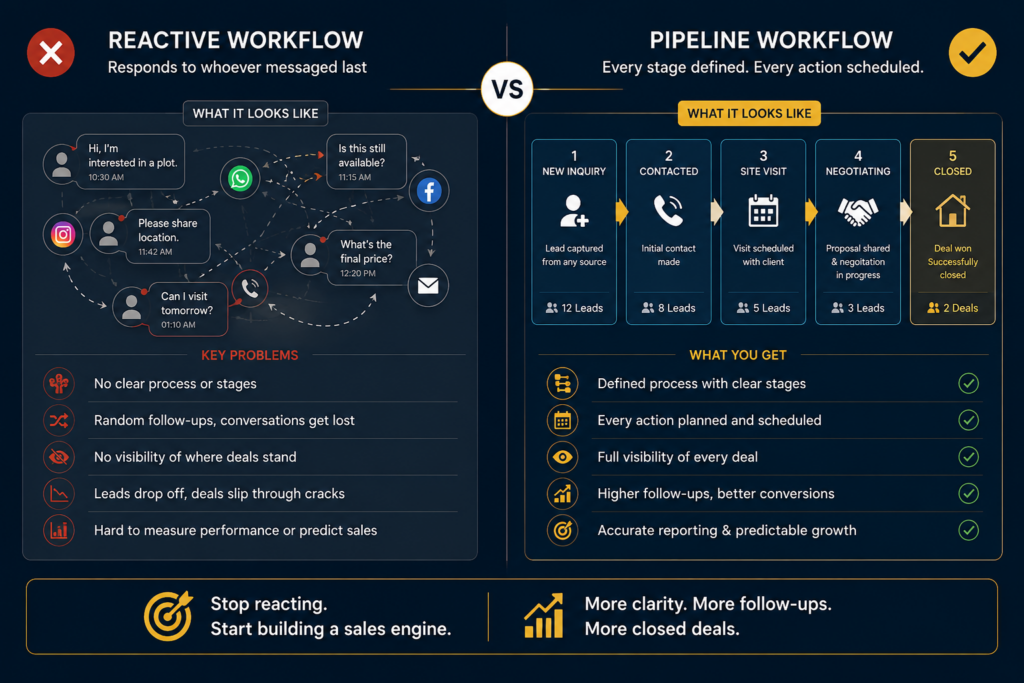
Stage 1: New Lead
Every inquiry should enter your pipeline as a new lead.
This includes:
- Website inquiries
- WhatsApp messages
- Facebook leads
- Referral contacts
- Phone calls
At this stage, the focus is on collecting accurate information and understanding client requirements.
A lead should never remain untracked.
Stage 2: Contacted
Once communication begins, the lead moves into the contacted stage.
This is where you:
- Understand buying or selling requirements
- Gather budget information
- Identify preferred locations
- Build initial trust
The goal is qualification.
Not every lead is ready to move forward immediately.
Understanding seriousness early helps prioritize effort.
Stage 3: Property Shared
After understanding requirements, suitable properties are presented.
At this stage:
- Listings are shared
- Questions are answered
- Client interest is evaluated
This stage provides valuable insight into buyer preferences.
The more accurately you track feedback, the easier future conversations become.
Stage 4: Site Visit Scheduled
A site visit often signals serious intent.
This stage requires careful coordination and follow-up.
Many deals are won or lost here.
Proper tracking ensures:
- Visits happen on time
- Client feedback is recorded
- Next steps are planned immediately
Without structure, momentum can disappear quickly after a visit.
Stage 5: Negotiation
At this stage, conversations become more detailed.
Pricing, terms, and expectations are discussed.
This is often where agents lose visibility if they do not have a system.
A proper pipeline helps track:
- Negotiation status
- Client concerns
- Follow-up schedules
- Closing probability
The clearer the process, the easier it becomes to move deals forward.
Stage 6: Closed or Lost
Every deal eventually reaches an outcome.
It is important to track both wins and losses.
Closed deals help measure performance.
Lost deals help identify weaknesses in the process.
Understanding why opportunities are lost is one of the fastest ways to improve future results.
Why a pipeline improves conversion rates
When agents use a structured sales pipeline, several things happen:
- Follow-ups become consistent
- Deal progress becomes visible
- Opportunities are prioritized correctly
- Response times improve
- Decision-making becomes easier
Most importantly, fewer leads disappear unnoticed.
Instead of reacting randomly, agents work proactively.
That difference directly impacts revenue.

How a real estate CRM supports pipeline management
Managing a pipeline manually can quickly become difficult.
This is where a real estate CRM becomes essential.
A CRM helps agents:
- Track leads automatically
- Move deals through stages
- Schedule follow-ups
- Record interactions
- Monitor performance
Everything becomes centralized and easy to manage.
Instead of searching through chats and spreadsheets, agents can see their entire business from one dashboard.
Where DealDesk fits into this process
Platforms like DealDesk are designed to help real estate professionals manage their sales pipeline efficiently.
DealDesk allows agents to:
- Organize leads systematically
- Track every deal stage
- Manage client interactions
- Schedule follow-ups
- Maintain complete visibility over opportunities
The result is a more predictable and scalable sales process.
Practical takeaways
If you want to build a stronger real estate sales pipeline:
- Track every lead from the first inquiry
- Create clear deal stages
- Record all client interactions
- Schedule follow-ups consistently
- Review your pipeline regularly
These simple practices create more visibility and improve conversion rates over time.
Final thought
A successful real estate business is not built on activity alone.
It is built on process.
The agents who understand exactly where every lead stands are the agents who make better decisions, serve clients more effectively, and close more deals.
If you want to grow consistently, start by building a sales pipeline that gives you complete visibility over your business.
Because what gets tracked gets managed.
And what gets managed gets improved.