

Most real estate agents know how much commission they expect to earn from a deal.
But ask them how much they actually earned over the last three months, and many struggle to give an accurate answer.
This is a common problem in the real estate industry.
Deals are closed, payments are received, commissions are shared, and expenses are deducted. Over time, keeping track of everything manually becomes difficult.
As a result, many agents lose visibility into one of the most important parts of their business:
Their earnings.
The problem is not the commission itself.
The problem is how it is tracked.
Why commission tracking matters
Real estate is a performance-driven business.
Your income depends on deals.
Every deal contributes to your overall revenue, and understanding exactly how much you are earning is critical for making smart business decisions.
Without proper commission tracking:
- Earnings become unclear
- Payments can be overlooked
- Profitability becomes difficult to measure
- Team commissions become harder to manage
- Business growth becomes difficult to plan
Many agents focus heavily on closing deals but pay very little attention to tracking the financial outcomes of those deals.
This creates unnecessary confusion.
Why manual commission tracking creates problems
Many property dealers still calculate commissions using notebooks, spreadsheets, or mental estimates.
While this may work for a few transactions, it becomes unreliable as the number of deals increases.
Common challenges include:
- Forgetting commission amounts from previous deals
- Losing records of payments received
- Difficulty tracking shared commissions
- Errors in manual calculations
- No visibility into monthly or yearly earnings
Over time, these small mistakes can create significant financial uncertainty.
And when you do not understand your numbers, managing growth becomes difficult.
The hidden cost of poor commission management
Many agents believe commission tracking is only important for accounting purposes.
In reality, it affects every part of the business.
Without accurate tracking:
- You cannot measure performance effectively
- Forecasting future revenue becomes difficult
- Team incentives become unclear
- Financial planning suffers
Most importantly, you lose visibility into what is actually driving your success.
A growing business needs clear financial data.
Not assumptions.
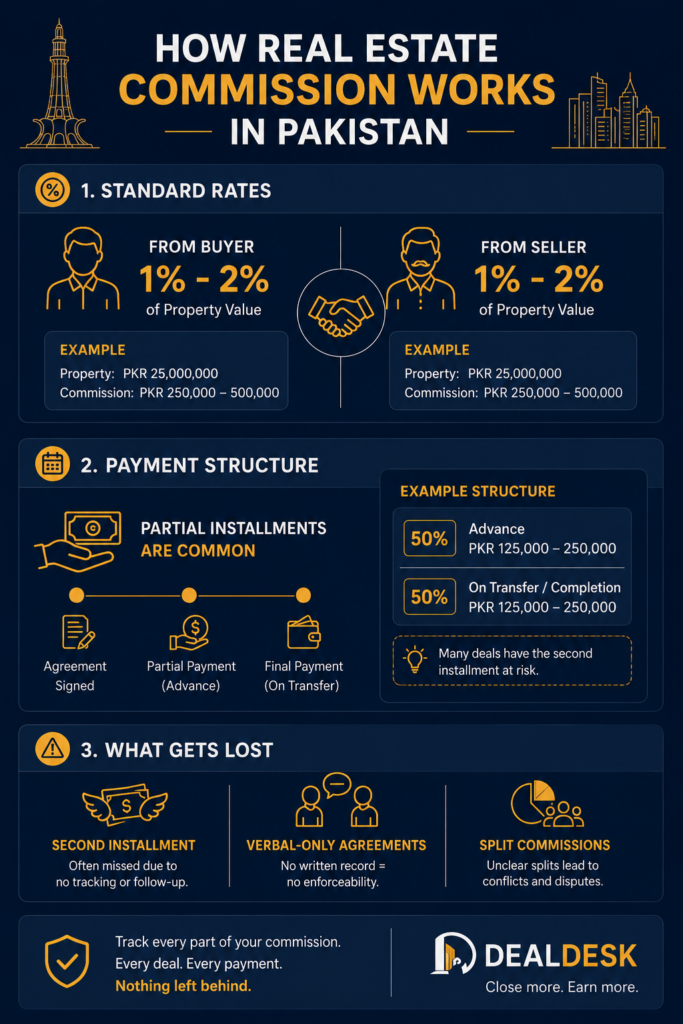
Step 1: Record every deal immediately
The first rule of commission tracking is simple.
Every deal should be recorded as soon as it is closed.
This should include:
- Client name
- Property details
- Deal value
- Commission percentage
- Expected commission amount
- Payment status
The sooner information is recorded, the less likely it is to be forgotten.
Consistency is more important than complexity.
Step 2: Separate expected and received commissions
One of the biggest mistakes agents make is treating expected earnings as completed earnings.
A commission should move through stages:
- Expected
- Invoiced
- Partially received
- Fully received
This creates a clear picture of actual cash flow.
Knowing what you have earned and what you have received are two different things.
Both should be tracked separately.
Step 3: Monitor commissions by month
Tracking commissions monthly provides valuable insights.
You can identify:
- Revenue trends
- Seasonal patterns
- High-performing periods
- Slow months
This helps with planning and decision-making.
Instead of guessing how the business is performing, you can rely on real numbers.
Step 4: Track shared commissions properly
Many real estate transactions involve multiple agents, partners, or agencies.
Without clear records, commission sharing can become confusing.
Every shared deal should include:
- Total commission amount
- Individual shares
- Payment status
- Settlement records
Proper documentation reduces disputes and improves transparency.
Step 5: Use a centralized system
As the number of transactions grows, manual tracking becomes inefficient.
A centralized system allows agents to:
- Record deals
- Calculate commissions automatically
- Monitor payment status
- Generate reports
- Track overall earnings
This reduces errors and saves significant time.

How a Real Estate CRM helps with commission tracking
Many modern real estate CRM systems include commission management features.
Instead of maintaining separate spreadsheets, agents can manage deals and commissions from a single platform.
A CRM helps:
- Link commissions directly to deals
- Track payment progress
- Monitor team earnings
- Generate financial reports
- Improve visibility into business performance
This creates greater accuracy and reduces administrative work.
Where DealDesk fits into this
Platforms like DealDesk are designed to help real estate professionals manage not only leads and deals but also commissions.
With DealDesk, agents can:
- Track deal values
- Monitor commission earnings
- Manage shared commissions
- Maintain complete financial visibility
- Organize business performance data in one place
The goal is to eliminate manual confusion and provide greater clarity over earnings.
Practical takeaways
If you want to improve commission tracking:
- Record every deal immediately
- Separate expected and received commissions
- Review earnings monthly
- Track shared commissions accurately
- Use a centralized management system
Small improvements in tracking can create significant improvements in financial visibility.
Final thought
Many real estate professionals spend years focusing on deals but never develop a clear understanding of their earnings.
The most successful agents do both.
They close deals and track performance.
Because growth is not only about generating revenue.
It is about understanding it.
And if you want to build a more profitable and sustainable real estate business, proper commission tracking is one of the most important habits you can develop.