

Managing a real estate business becomes much more challenging when you are no longer working alone.
As your agency grows, so does your team.
New agents join. More deals are active. Clients expect faster responses. Properties need to be assigned. Follow-ups must happen on time. Commissions need to be tracked accurately.
Many agency owners respond by trying to oversee everything themselves.
They approve every decision, monitor every conversation, and constantly check on every team member.
At first, this feels like staying in control.
Over time, it becomes exhausting.
The business slows down because every decision depends on one person.
The problem is not your team.
The problem is managing people without a system.
Why micromanagement hurts real estate agencies
Many agency owners believe constant supervision leads to better performance.
In reality, it often creates the opposite result.
When every task requires approval:
- Decisions become slower.
- Agents lose confidence.
- Productivity decreases.
- Team members become dependent instead of accountable.
Instead of focusing on growing the business, managers spend their day answering routine questions and checking work that should already be organized.
This creates unnecessary pressure for everyone.
Why growing teams become difficult to manage
Managing one or two agents is relatively simple.
Managing ten or twenty agents is a completely different challenge.
Without structured real estate agency operations, managers struggle to answer important questions:
- Which agent is handling which client?
- Which deals are progressing?
- Who missed a follow-up?
- Which properties have already been shared?
- How many deals is each agent managing?
- Which commissions are pending?
When this information is scattered across WhatsApp chats, spreadsheets, and phone calls, visibility disappears.
And without visibility, management becomes guesswork.
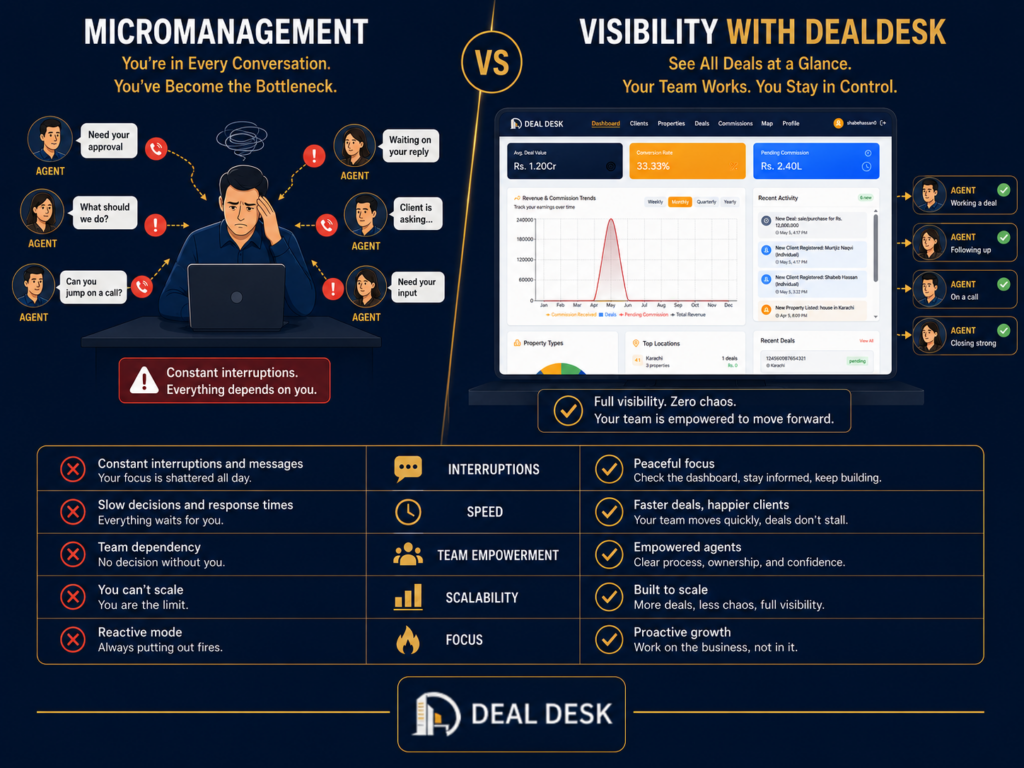
The biggest misconception about leadership
Many people believe good managers constantly monitor their team.
Successful managers do something different.
They build systems that allow the team to work independently.
Their goal is not to control every action.
Their goal is to create accountability.
When everyone understands their responsibilities and progress is visible, managers no longer need to ask for constant updates.
The system provides the answers.
Build clear workflows instead of constant supervision
One of the best ways to reduce micromanagement is by creating standardized workflows.
For example:
Every new lead follows the same process.
Every property inquiry is recorded.
Every follow-up is scheduled.
Every deal moves through defined stages.
Every closed transaction is documented.
When everyone follows the same workflow, mistakes become easier to identify and performance becomes easier to measure.
Consistency replaces confusion.
Give your team visibility
Agents perform better when they know exactly what needs attention.
A centralized dashboard helps every team member see:
- Assigned clients
- Active deals
- Upcoming follow-ups
- Pending site visits
- Deal progress
- Commission status
Instead of waiting for instructions, agents can manage their own workload confidently.
Managers spend less time checking progress and more time supporting growth.
Measure performance with data
Managing a team becomes easier when decisions are based on facts instead of assumptions.
Track key performance indicators such as:
- New leads assigned
- Follow-up completion rate
- Deals closed
- Conversion rate
- Response time
- Commission generated
These insights help managers coach their team effectively without monitoring every individual conversation.

Why technology changes team management
Modern real estate agencies rely on systems rather than memory.
A real estate CRM gives managers complete visibility into team performance while allowing agents to work independently.
Instead of asking for daily updates, managers can immediately see:
- What each agent is working on
- Which deals need attention
- Which follow-ups are overdue
- Overall business performance
This creates transparency without unnecessary supervision.
Where DealDesk fits into this
This is where DealDesk helps agencies simplify real estate agency operations.
Instead of managing agents through spreadsheets and messaging apps, DealDesk provides one centralized platform for the entire team.
With DealDesk, managers can:
- Assign leads to agents
- Track deal progress in real time
- Monitor follow-ups
- Share properties with clients and dealers
- Manage commissions
- View team performance through a single dashboard
Agents know exactly what they need to do, while managers gain complete visibility without constantly checking on everyone.
The result is a more productive team and a more scalable business.
Practical takeaways
If you want to manage your real estate team without micromanaging:
- Create standardized workflows
- Centralize all client and deal information
- Give every agent clear responsibilities
- Measure performance using data
- Use a CRM to improve visibility across the team
When systems improve, management becomes simpler.
Final thought
Great real estate agencies are not built by managers who oversee every small task.
They are built by leaders who create systems that allow their teams to perform independently.
Micromanagement may solve today’s problems.
A structured process solves tomorrow’s.
If your agency is growing, focus on building systems that create accountability, improve collaboration, and give your team the tools they need to succeed.
Because the strongest real estate businesses are powered by people working within the right system, not by managers trying to control every step.