

Every successful real estate agency starts small.
A few clients.
A handful of property listings.
One or two agents managing everything.
In the early stages, running the business manually feels manageable. Client information is stored in spreadsheets, property details are shared through WhatsApp, and follow-ups are remembered without much difficulty.
But as the agency begins to grow, something changes.
More leads start coming in.
More agents join the team.
More deals are active at the same time.
Suddenly, the systems that once worked begin to break down.
Instead of becoming more efficient, the agency becomes more chaotic.
This is one of the biggest reasons many small real estate agencies struggle to scale.
Growth creates complexity
Growth is exciting, but it also introduces new challenges.
As the number of clients and properties increases, agency owners need to manage:
- More client inquiries
- More property listings
- More follow-ups
- More negotiations
- More team members
- More commissions
- More documents
Without proper systems, every new client adds more work instead of more value.
The agency becomes busier, but not necessarily more productive.
Why manual processes stop working
Many small agencies continue using the same methods even after their business grows.
They rely on:
- WhatsApp conversations
- Excel spreadsheets
- Phone call history
- Personal reminders
- Paper notes
These tools work for communication and record keeping, but they do not create an organized workflow.
As the workload increases:
- Client information becomes scattered.
- Follow-ups are missed.
- Duplicate records appear.
- Property updates become difficult to track.
- Team collaboration slows down.
Eventually, the agency reaches a point where growth feels overwhelming instead of rewarding.
The hidden cost of poor organization
Scaling is not only about generating more leads.
It is about handling more business without losing quality.
When systems are missing:
- Response times become slower.
- Clients receive inconsistent communication.
- Agents duplicate work.
- Opportunities are missed.
- Customer satisfaction declines.
These problems limit growth, even when demand continues to increase.
The agency may appear busy, but its operations become increasingly inefficient.
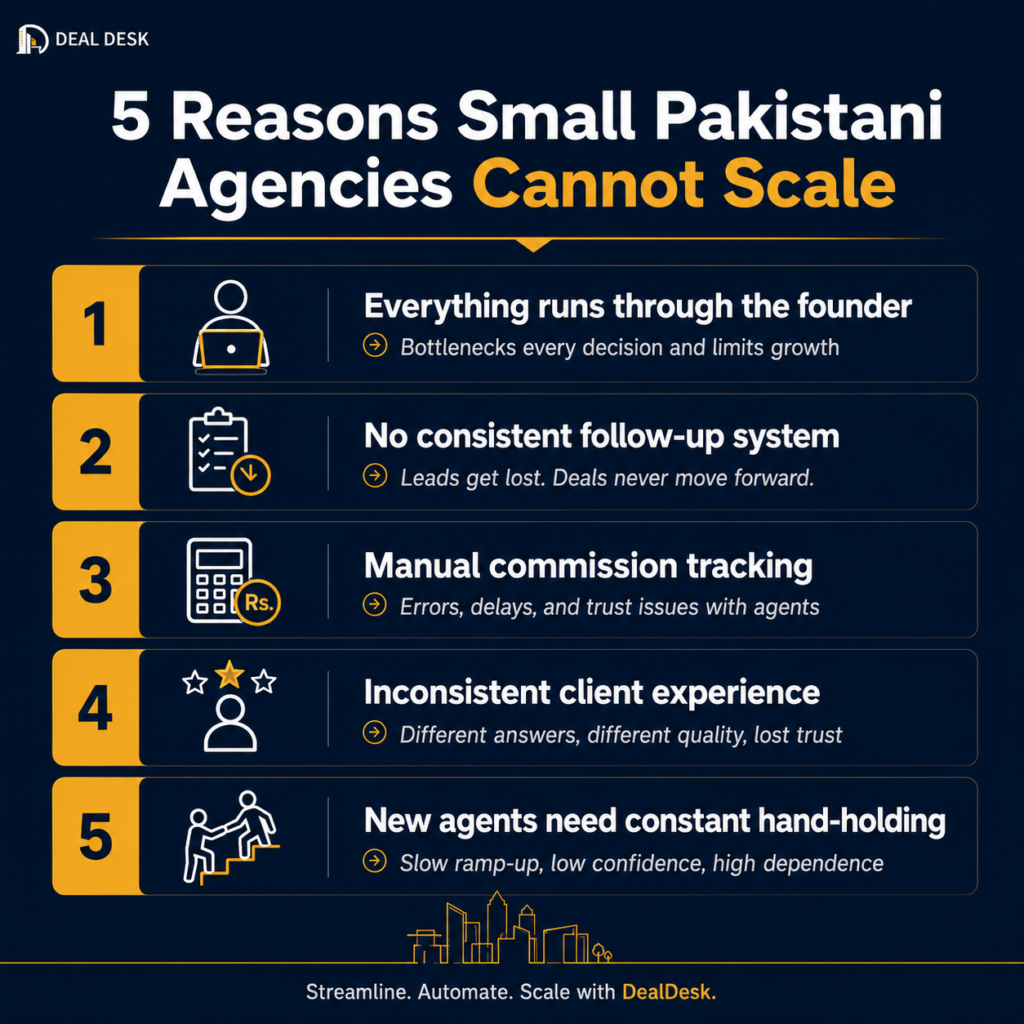
Why hiring more people is not always the answer
Many agency owners believe adding more staff will solve operational problems.
In reality, more people without better systems often create more confusion.
Every new employee needs access to client information.
They need visibility into active deals.
They need to understand previous conversations.
Without centralized information, communication becomes fragmented.
The agency spends more time coordinating work than completing it.
Systems must grow before teams grow.
Build processes before expanding
Successful agencies focus on creating repeatable processes.
Every new lead should follow the same workflow.
Every property should have complete information.
Every client interaction should be recorded.
Every follow-up should be scheduled.
Every deal should move through clearly defined stages.
When processes are standardized, scaling becomes much easier.
Consistency replaces confusion.
The role of technology in agency growth
Technology allows agencies to grow without losing control.
Instead of managing information across multiple platforms, everything becomes centralized.
Using software for managing property clients allows agencies to:
- Organize client records
- Track property requirements
- Manage follow-ups automatically
- Monitor deal progress
- Improve team collaboration
- Reduce administrative work
This creates visibility across the entire business.
Managers can focus on strategy while agents focus on serving clients.
Why visibility matters
One of the biggest advantages of using modern systems is visibility.
Agency owners can immediately understand:
- Which leads are active
- Which deals are close to closing
- Which clients need follow-up
- Which agents are performing well
- Which commissions are pending
Without this visibility, growth becomes unpredictable.
With it, decisions become faster and more accurate.

Where DealDesk helps
This is where DealDesk supports growing real estate agencies.
Instead of relying on disconnected tools, DealDesk brings clients, properties, deals, commissions, documents, and team activities into one centralized platform.
With DealDesk, agencies can:
- Manage property clients efficiently
- Assign leads to agents
- Track every deal through a visual pipeline
- Schedule follow-ups automatically
- Share properties with clients and dealers
- Monitor commissions and team performance
- Keep all business information organized in one place
As the agency grows, the system grows with it.
That allows teams to scale without losing efficiency.
Practical takeaways
If your agency is preparing for growth:
- Standardize your daily workflows.
- Centralize client and property information.
- Stop relying on spreadsheets and memory.
- Improve collaboration across your team.
- Invest in software for managing property clients before operational problems appear.
Building strong systems today makes future growth much easier.
Final thought
The agencies that grow successfully are not always the ones with the largest marketing budgets or the most agents.
They are the ones with the strongest systems.
Growth should create more opportunities, not more confusion.
By organizing your workflows, centralizing your information, and adopting the right technology, you create a business that can handle more clients, more deals, and more success without losing control.
Because scaling a real estate agency is not about doing more work.
It is about building a system that allows your business to grow efficiently.