

Real estate marketing has changed.
Today, almost every property dealer understands the importance of social media.
They create property videos.
They post Reels.
They upload Stories.
They share listings on Facebook and Instagram.
Some even invest heavily in professional photography and video production.
But there is one important question most agencies do not ask:
What happens after someone shows interest?
Because creating content is only one part of real estate marketing.
The real challenge begins when that content generates a lead.
If the lead is not captured, followed up, organized, and converted, even the best video can become a missed opportunity.
Content gets attention. Systems turn attention into business.
A property video might reach thousands of people.
Someone may watch the entire Reel, visit your profile, send a message, or ask for the price.
That is a positive result.
But a view is not a client.
A follower is not a deal.
And an inquiry is not revenue.
There is a complete journey between someone discovering your content and becoming a customer.
That journey needs a system.
What happens when someone responds to your social media post?
Imagine your agency posts a video for a property in Islamabad.
A potential buyer sees it and sends:
“Price?”
Your agent responds.
The buyer asks for more pictures.
You send them.
Then the buyer says:
“I’ll let you know.”
A few hours later, another ten inquiries arrive.
Then calls start coming in.
Another agent is dealing with site visits.
Someone needs to follow up with yesterday’s leads.
The original buyer’s conversation gets buried.
Three days later, nobody remembers to contact them.
The content worked.
The marketing worked.
The lead was interested.
But the system failed.
The biggest mistake real estate agencies make
Many agencies measure social media success using:
- Views
- Likes
- Followers
- Shares
- Comments
These metrics are useful, but they do not tell you how much business your marketing is actually generating.
A better question is:
How many qualified leads did this content generate, and how many of those leads became deals?
That is where real estate marketing becomes a business process rather than simply content creation.
Social media should be the beginning of the process
Your social media strategy should not end when you publish a video.
It should start a workflow.
For example:
Content → Inquiry → Lead Capture → Qualification → Property Matching → Follow-Up → Site Visit → Negotiation → Deal
Every stage matters.
If your agency is excellent at creating content but weak at managing leads, you have only solved the first part of the problem.
Why leads get lost after social media inquiries
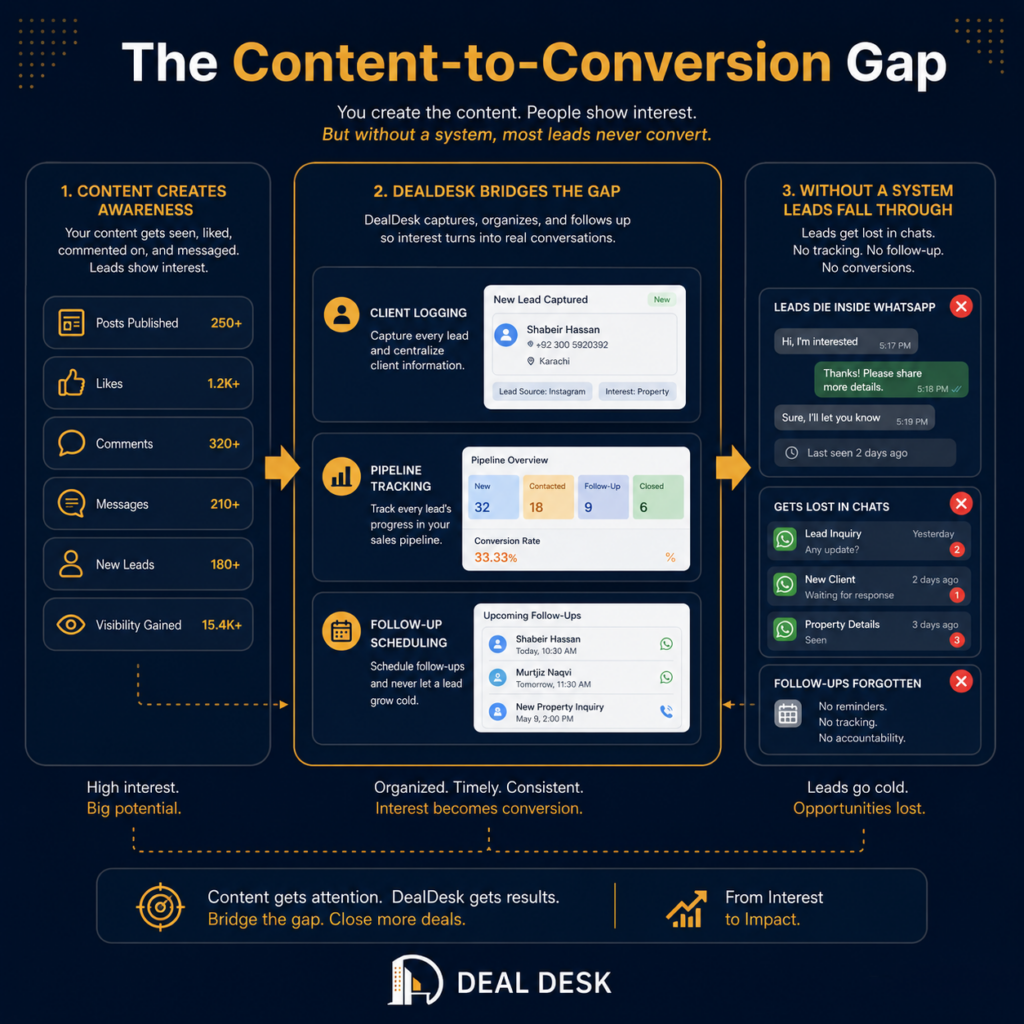
Most agencies receive leads through multiple channels.
A buyer might contact you through:
- Phone calls
- Website forms
- Property portals
- Referrals
When these inquiries are handled separately, it becomes difficult to maintain visibility.
Some leads remain in WhatsApp.
Others are written into Excel.
Some stay inside an agent’s phone.
Others may never be recorded at all.
This creates one of the biggest problems in modern real estate marketing:
You are generating leads, but you do not have complete control over them.
The importance of lead management
A successful real estate agency needs to know what happens to every inquiry.
When a new lead arrives, your team should be able to identify:
- Who is the client?
- What property are they interested in?
- What is their budget?
- Which location do they prefer?
- Which agent is handling them?
- When was the last follow-up?
- What should happen next?
- Is the lead still active?
Without this information, your marketing performance becomes difficult to measure.
With it, you can understand exactly where your leads are coming from and where they are going.
This is where a Real Estate CRM becomes important
A Real Estate CRM connects your marketing activity with your sales process.
Instead of treating every social media inquiry as another message in a crowded inbox, you can turn it into a properly managed lead.
A CRM can help your team:
- Capture new leads
- Organize client information
- Assign leads to agents
- Track follow-ups
- Manage property requirements
- Monitor deal stages
- Measure conversions
This creates a connection between marketing and sales.
Your content attracts attention.
Your CRM helps your team turn that attention into opportunities.
Don’t just create more content. Build a better process.
If your agency is already producing videos consistently, the next question should not always be:
“What should we post tomorrow?”
Sometimes the better question is:
“What are we doing with the people who responded to yesterday’s post?”
You may already have hundreds of potential clients sitting inside old conversations.
Some may have been interested but never followed up.
Some may still be looking for a property.
Some may simply need the right property recommendation at the right time.
Before spending more money generating new leads, make sure your agency has a system for managing the leads it already receives.
Where DealDesk fits into this
This is where DealDesk helps real estate agencies connect marketing with business operations.
Instead of letting leads remain scattered across different platforms, DealDesk helps your team organize them inside a centralized system.
Your team can manage:
- Clients
- Properties
- Leads
- Deal stages
- Follow-ups
- Documents
- Commissions
- Property sharing
This means your social media activity does not have to exist separately from your sales process.
A lead generated from your marketing can become part of a structured workflow where your team knows what to do next.
Measure what actually matters
Social media metrics are useful, but real estate agencies should go beyond vanity metrics.
Track metrics such as:
Content views → Leads generated → Qualified leads → Site visits → Negotiations → Closed deals
This gives you a much clearer picture of your marketing ROI.
A video with 100,000 views and zero qualified leads may be less valuable than a video with 5,000 views that generates several serious buyers.
The objective is not simply to get attention.
The objective is to create business.
Practical takeaways
If your real estate agency is investing heavily in social media, make sure you also have:
- A proper lead capture process
- Centralized client information
- Clear lead assignment
- Consistent follow-up
- A structured sales pipeline
- Property and client matching
- Deal tracking
- Performance reporting
Content creates opportunities.
Systems help you capitalize on them.

Final thought
Making videos and posting consistently is important.
But content alone cannot build a scalable real estate business.
Your videos can generate attention.
Your social media can generate inquiries.
Your marketing can generate leads.
But without a system to manage those leads, a significant portion of that effort can disappear.
The real competitive advantage is not simply being the agency that posts the most content.
It is being the agency that knows exactly what to do after someone responds.
Because in modern real estate, the winning formula is not just:
Create → Post → Repeat.
It is:
Create → Capture → Manage → Follow Up → Convert → Close.
That is how social media becomes a real business growth engine.