

Getting real estate leads is not the hardest part of running a real estate business.
The real challenge is converting those leads into paying clients.
Many agencies invest heavily in Facebook Ads, property portals, social media, referrals, and marketing campaigns. They generate hundreds of inquiries, but only a small percentage turn into actual deals.
Why?
Because a lead is not a client.
Between the moment someone sends an inquiry and the moment they sign a deal, there are dozens of opportunities to lose them.
The difference between a real estate agency that consistently closes deals and one that constantly chases leads often comes down to one thing:
The system behind the sales process.
A Lead Without a Process Is Just a Contact
Imagine someone submits a Facebook lead form asking about a property.
What happens next?
If the process looks like this:
Facebook Lead → WhatsApp → Agent → Follow-up → Excel Sheet → Phone Call → More WhatsApp
there is a high chance that something will be missed.
The agent may forget to follow up.
The lead may be assigned to the wrong person.
The client’s requirements may not be recorded.
A property shared with the client may never be followed up on.
And after a few days, nobody knows what happened.
This is how valuable leads disappear.
Build a Lead Conversion System, Not Just a Lead List
A good real estate lead conversion system should define exactly what happens from the first interaction to the final deal.
A simple process could look like:
Lead Captured → Lead Assigned → Client Qualified → Properties Matched → Follow-up → Property Visit → Negotiation → Deal Closed
Every stage should have a clear action.
Without defined stages, agents tend to work based on memory.
With defined stages, the entire team follows the same process.
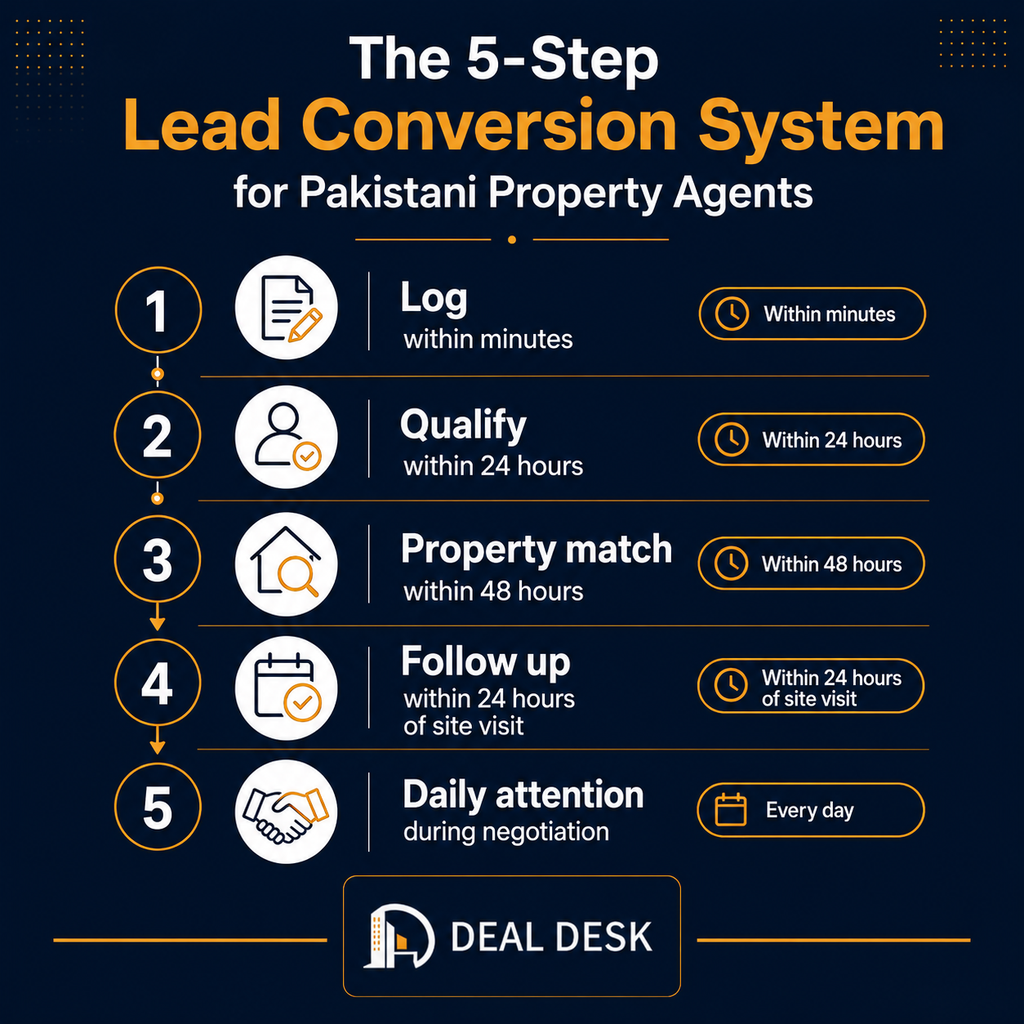
Step 1: Capture Every Lead Automatically
The first step is making sure no lead gets lost.
Leads can come from:
- Facebook and Instagram campaigns
- Website forms
- Property portals
- Phone calls
- Referrals
- Walk-in clients
- Existing customers
Your system should bring these leads into one central place.
Instead of asking:
“Who received this lead?”
your team should be able to immediately see:
- Client name
- Contact information
- Source
- Property interest
- Budget
- Location preference
- Assigned agent
- Lead status
- Last follow-up
- Next action
This creates accountability from the beginning.
Step 2: Qualify the Lead Before Chasing Them
Not every inquiry has the same potential.
One person may be ready to purchase this week.
Another may be researching properties for the next six months.
Another may simply be asking for prices.
Your team should capture important information such as:
Budget: What can the client afford?
Requirement: What exactly are they looking for?
Location: Which areas are they interested in?
Timeline: When are they planning to buy or rent?
Purpose: Investment or personal use?
This information allows agents to focus their time on the right opportunities.
Step 3: Match Clients With the Right Properties
Once a client’s requirements are clear, the next step is matching them with suitable properties.
This is where many agencies still rely heavily on WhatsApp conversations and personal knowledge.
A better system keeps property information organized so agents can quickly identify suitable options.
For example:
Client: Looking for a 10 Marla house in Bahria Town, budget up to PKR 4 crore.
Instead of manually asking multiple agents, the system should help identify properties that match those requirements.
The faster you provide relevant options, the more professional the client experience becomes.
Step 4: Make Follow-Ups Part of the System
One of the biggest reasons real estate leads don’t convert is simple:
Nobody follows up consistently.
A client might say:
“I’ll think about it.”
That doesn’t necessarily mean they are not interested.
They might need:
- Another property
- A better price
- More information
- Time to discuss with family
- Financing confirmation
- A few days before making a decision
Without a structured follow-up process, the opportunity disappears.
A proper system should show agents:
Who needs a follow-up today?
Who hasn’t been contacted recently?
Which leads are waiting for a response?
Which clients have already viewed a property?
Follow-up should not depend on someone’s memory.
Step 5: Track Every Interaction
Every important interaction should become part of the client’s history.
For example:
Monday: Client contacted the agency.
Tuesday: Agent shared three properties.
Wednesday: Client rejected two properties.
Thursday: Client requested properties in another location.
Saturday: Property visit scheduled.
Monday: Client made an offer.
Now imagine another agent takes over the client.
They don’t need to ask:
“What happened with this client?”
They can simply look at the history.
This is the difference between individual agent knowledge and organizational knowledge.
Step 6: Create Clear Lead Stages
Your CRM should make it obvious where every lead currently stands.
For example:
New Lead
↓
Contacted
↓
Qualified
↓
Properties Shared
↓
Visit Scheduled
↓
Negotiation
↓
Deal Closed
↓
Lost / Nurture
This gives management a complete view of the sales pipeline.
Instead of saying:
“We have a lot of leads.”
you can ask:
How many qualified leads do we have?
How many property visits are scheduled?
How many are currently negotiating?
How many deals are expected to close this month?
Those are much more useful business questions.
Step 7: Measure Where Leads Are Being Lost
A good system doesn’t only tell you how many leads you received.
It tells you why they didn’t convert.
For example:
| Stage | Leads |
|---|---|
| Total Leads | 500 |
| Contacted | 450 |
| Qualified | 280 |
| Properties Shared | 220 |
| Visits | 90 |
| Negotiations | 35 |
| Closed Deals | 12 |
Now you can investigate the gaps.
Why did 170 leads fail to become qualified?
Why did only 90 clients reach the property visit stage?
Why did 35 negotiations result in only 12 deals?
This data helps management improve the process instead of simply spending more money on advertising.
Your CRM Should Become the Operating System of Your Sales Team
A Real Estate CRM should not simply be a database of names and phone numbers.
It should help your team manage the entire relationship.
That means connecting:
Leads + Clients + Properties + Agents + Follow-ups + Deals + Documents + Commissions
When these pieces are connected, your team gets a complete picture of the business.

Where DealDesk Fits In
This is exactly where a platform like DealDesk can become valuable.
Instead of managing clients, properties, deals, documents, and follow-ups across different tools, a centralized system gives your team one place to manage the complete process.
The goal isn’t simply to store more information.
The goal is to create a repeatable system where:
Every lead gets captured.
Every lead gets assigned.
Every client gets followed up with.
Every requirement gets recorded.
Every property interaction gets tracked.
Every deal has a clear history.
That is how technology becomes part of the sales process rather than just another piece of software.
Practical Takeaway
If your agency wants to convert more real estate leads, don’t start by asking:
“How can we generate more leads?”
Start by asking:
“What happens after we receive a lead?”
If the answer depends on individual agents remembering what to do, your business has a conversion problem.
Build the system first.
Then increase the leads flowing into it.
Because generating 1,000 leads means very little if your team doesn’t have a reliable process for converting them into clients.
Final Thought
Real estate sales are built on relationships, but relationships need systems to scale.
The agencies that win consistently will not necessarily be the ones generating the most leads.
They will be the ones that capture, qualify, follow up, and convert those leads more efficiently than everyone else.
Don’t just generate leads. Build a system that turns them into business.
Explore DealDesk and see how a centralized real estate business management system can help your team manage leads, clients, properties, and deals more effectively.