
Most real estate businesses are focused on finding the next client.
The next buyer.
The next seller.
The next investor.
The next deal.
But there is an asset sitting inside almost every real estate agency that is often overlooked:
The client list.
A strong client database can become one of the most valuable assets your real estate business owns.
Because a client is not valuable only when they are ready to buy today.
They can become valuable again months or even years later.
The problem is that many agencies lose this long-term opportunity because they never properly organize the relationships they have already built.
A closed deal should not mean the relationship ends
Imagine you helped someone purchase a property three years ago.
The transaction was completed.
The commission was received.
The client disappeared from your daily operations.
Then, three years later, that same person decides to:
- Buy another property
- Sell their existing property
- Make an investment
- Recommend an agent to a family member
- Refer a business contact
If your agency still has their information, you already have a relationship.
If their details disappeared with an old WhatsApp conversation, you are starting from zero again.
This is why real estate client management is about more than managing today’s transactions.
It is about building relationships that continue creating value.
Your client database is a business asset
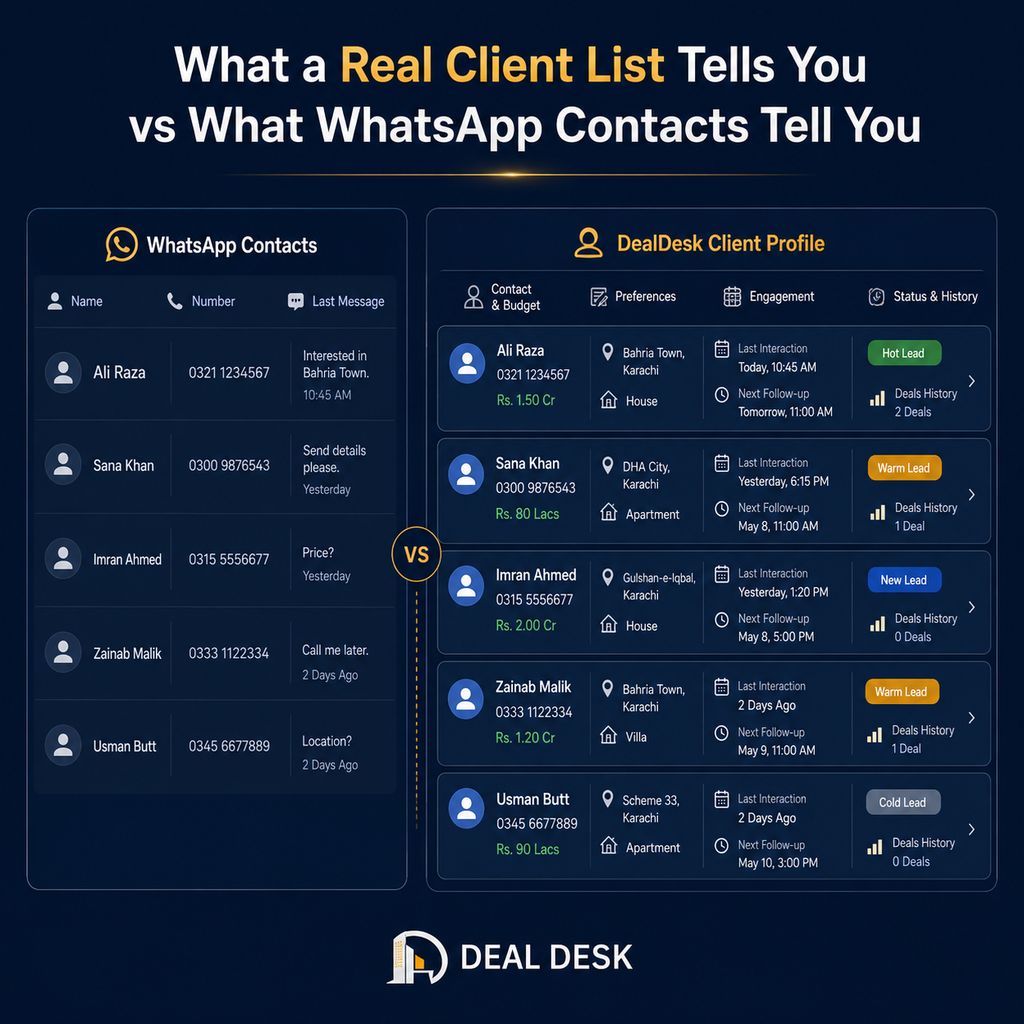
A client list is not simply a collection of names and phone numbers.
A useful real estate client database can contain:
- Contact information
- Property preferences
- Budget
- Preferred locations
- Previous interactions
- Properties shared
- Site visits
- Deal history
- Follow-up dates
- Important notes
Over time, this information becomes incredibly valuable.
It helps your team understand who your clients are and what they may need in the future.
The problem with keeping clients only in WhatsApp
WhatsApp is excellent for communication.
But it is not a long-term customer relationship management system.
Think about how many conversations an agent can have in one year.
Hundreds or thousands.
Finding a conversation from two years ago can become almost impossible.
Even if you find it, important information may be buried between unrelated messages.
And if an employee leaves the agency, valuable relationships can leave with them.
Your client relationships should belong to the business, not an individual phone.
A client list creates future opportunities
Consider a client who previously wanted a property in a specific location but could not find the right opportunity.
If their requirement is properly recorded, your team can contact them when a suitable property becomes available.
Instead of waiting for the client to contact you, you can proactively reach out.
That changes the relationship.
You are no longer simply reacting to inquiries.
You are actively managing opportunities.
Your old clients can become your future leads
One of the biggest advantages of building a strong client database is that you don’t always need to acquire a completely new audience.
Your existing clients can generate:
Repeat business
Referrals
Investment opportunities
Property sales
New buyer relationships
A satisfied client can potentially introduce you to multiple new opportunities.
That makes maintaining relationships one of the most cost-effective growth strategies for a real estate agency.
The bigger your business becomes, the more important your database gets
For an individual agent, remembering clients may seem manageable.
For a growing agency, it becomes impossible.
Imagine managing 2,000 clients across a team of 15 agents.
You cannot expect everyone to remember every conversation.
You need a system.
The agency needs to know:
- Who the client is
- Which agent manages them
- What they are looking for
- What properties were previously shared
- When they were last contacted
- Whether they have completed a deal
- What their next potential requirement could be
Without centralized information, this knowledge becomes fragmented.
With a proper CRM, it becomes part of the company’s infrastructure.
Build your database before you need it
One of the biggest mistakes agencies make is waiting until they need a client to start organizing their information.
By then, it may already be too late.
Start building your database from the first interaction.
When a new lead arrives, capture the information.
When a client changes their requirements, update the record.
When a deal closes, keep the relationship active.
When a client refers someone, record the connection.
Over time, these small actions create a powerful business asset.
Use your client database intelligently
Building a client list is only the first step.
The real value comes from using it properly.
For example, you could segment clients based on:
- Buyer vs. seller
- Budget range
- Preferred location
- Property type
- Investment interest
- Previous transactions
- Current requirements
This allows your team to communicate more intelligently.
Instead of sending the same property to everyone, you can share relevant opportunities with the clients who are actually likely to be interested.
That creates better communication and a better client experience.
This is where a Real Estate CRM becomes valuable
A Real Estate CRM allows your agency to turn scattered contacts into structured relationships.
Instead of keeping client information across spreadsheets, notebooks, WhatsApp chats, and personal phones, your team can maintain a centralized database.
A CRM can help you:
- Organize client profiles
- Record client preferences
- Track interactions
- Schedule follow-ups
- Connect clients with properties
- Track deal history
- Manage documents
- Monitor team activity
This gives your agency something extremely valuable:
A complete view of the customer relationship.
Where DealDesk fits in
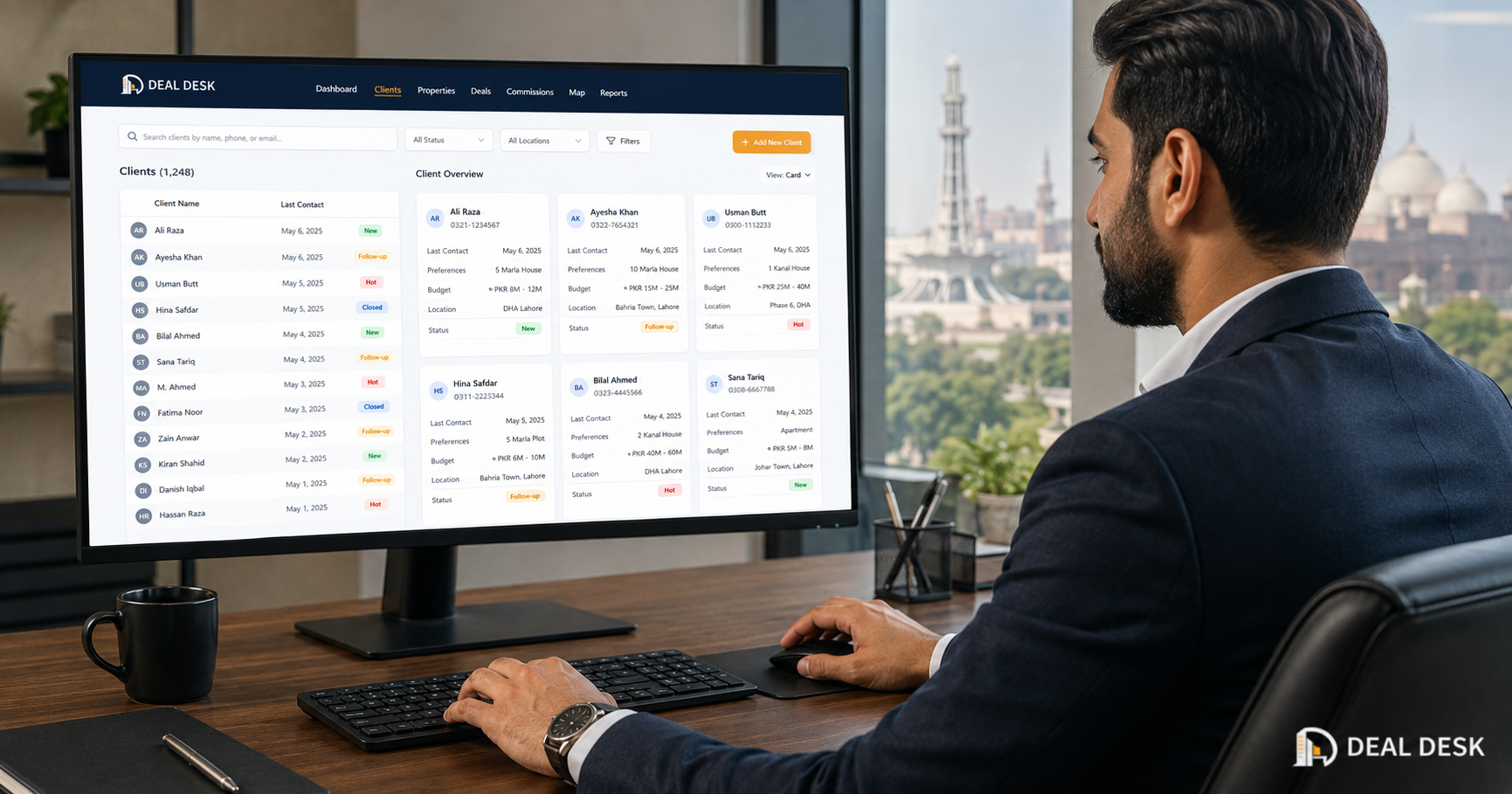
DealDesk is built to help real estate professionals manage the entire relationship between clients, properties, and deals.
Instead of treating a client as just another contact, DealDesk allows your business to keep their information connected with the activities that matter.
Your team can manage clients alongside:
- Properties
- Deals
- Follow-ups
- Documents
- Commissions
- Property sharing
This means that when a client returns months later, your team has context.
They don’t have to ask:
“Who was this client?”
They can understand the relationship and continue from where they left off.
The goal is not to collect contacts
There is an important difference between having a list of phone numbers and having a valuable client database.
A list tells you who someone is.
A proper CRM tells you:
Who they are.
What they need.
What they have seen.
What they previously bought.
Who manages them.
When you should contact them again.
That information creates opportunities.

Practical takeaways
If you want to build a valuable real estate client database:
- Record every serious inquiry.
- Keep client information centralized.
- Document property preferences.
- Track previous interactions.
- Record completed deals.
- Schedule future follow-ups.
- Keep relationships accessible to the business, not just individual agents.
- Use your database to proactively identify new opportunities.
The objective is to build a long-term relationship engine, not simply a contact list.
Final Thought
The next big deal in your business may not come from a brand-new lead.
It may come from someone you already helped.
Someone whose number is currently buried in an old WhatsApp conversation.
Someone who bought a property from you years ago.
Someone who once asked about a property but was not ready at the time.
Someone who could refer their next client.
That is why building a client list is one of the most valuable things you can do in real estate.
Every relationship you build today can become an opportunity tomorrow.
Don’t let those relationships disappear when the conversation ends.
Build a system that remembers your clients, understands their history, and helps your team turn relationships into long-term business.
Ready to turn your client list into a structured business asset?
Manage your clients, properties, deals, documents, and commissions in one centralized platform.