

Pakistan’s real estate industry is changing faster than ever.
A few years ago, success was largely determined by who had the strongest network, the most listings, or the best location.
Today, the market is different.
Clients are more informed.
Competition is increasing.
Digital marketing has transformed lead generation.
Technology is changing how agencies operate.
The agencies that adapt to these changes will continue to grow.
Those that don’t may find it increasingly difficult to compete.
The future of real estate in Pakistan is no longer about working harder.
It is about building better systems.
The market is becoming more competitive
Property buyers today have access to more information than ever before.
Within minutes they can:
- Compare property prices
- Explore multiple housing societies
- View listings online
- Contact several agents
- Read reviews before making decisions
This has shifted the balance of power.
Clients now expect faster communication, greater transparency, and a more professional experience.
Meeting those expectations requires more than experience.
It requires organization.
The traditional way of working is reaching its limits
Many real estate businesses still rely on methods that worked years ago.
Client information is stored in WhatsApp chats.
Property records are maintained in Excel files.
Follow-ups depend on memory.
Documents are spread across different folders.
As business grows, these methods become increasingly difficult to manage.
The result is familiar:
- Missed follow-ups
- Lost leads
- Delayed responses
- Poor team coordination
- Inconsistent client experiences
These are not just operational problems.
They directly affect revenue.
Why systems are becoming a competitive advantage
The agencies that consistently perform well have something in common.
They do not rely on individuals to remember everything.
They rely on systems.
A structured workflow allows agencies to:
- Capture every lead
- Organize every client
- Track every property
- Monitor every deal
- Schedule every follow-up
- Record every commission
When information is centralized, the business becomes easier to manage.
Instead of reacting to daily problems, teams work proactively.
The shift from survival to scalability
Many agencies spend most of their time solving immediate problems.
They respond to messages.
Search for documents.
Check spreadsheets.
Call team members for updates.
This keeps the business running.
But it does not help it grow.
Scalable agencies spend less time managing chaos because their processes are already organized.
That gives them more time to focus on:
- Winning new business
- Improving client relationships
- Expanding into new markets
- Training their teams
- Building long-term strategies
The difference is clear.
One business survives.
The other scales.
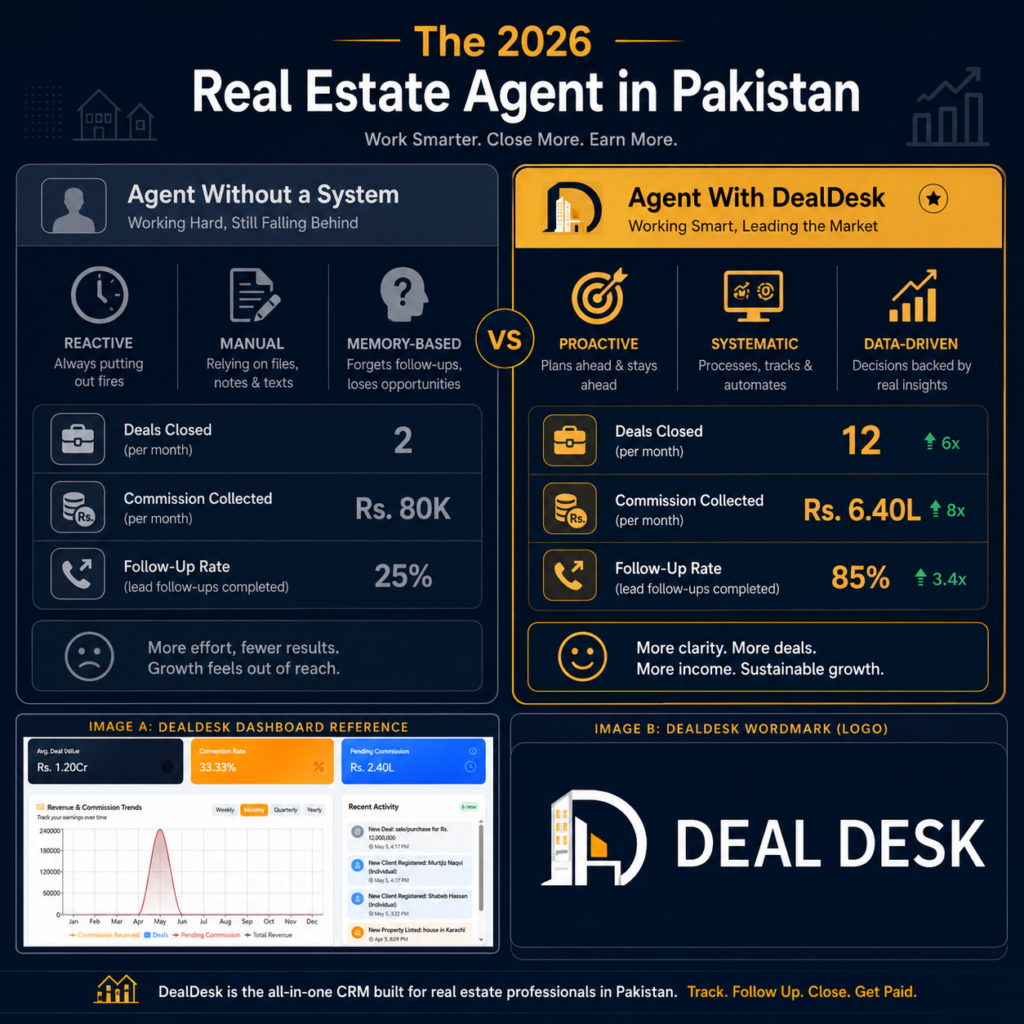
Technology is reshaping the industry
Technology is no longer a luxury for large agencies.
It has become a practical necessity for businesses of every size.
Modern real estate businesses use technology to:
- Manage client relationships
- Organize property listings
- Track deal progress
- Automate follow-ups
- Store documents securely
- Monitor business performance
These tools reduce manual work while improving accuracy and efficiency.
Instead of replacing people, technology helps people perform better.
Why client experience will define future success
As competition grows, properties alone will no longer differentiate agencies.
Client experience will.
Buyers and sellers will choose agencies that:
- Respond quickly
- Stay organized
- Communicate consistently
- Understand their requirements
- Keep them informed throughout the transaction
Professional service creates trust.
Trust creates referrals.
And referrals create sustainable growth.
The agencies that invest in client experience today will build stronger businesses tomorrow.
Data-driven decisions will replace assumptions
Successful agencies are increasingly relying on data instead of intuition.
They monitor:
- Lead conversion rates
- Agent performance
- Response times
- Active deals
- Revenue trends
- Commission reports
These insights help managers identify opportunities, improve performance, and make better business decisions.
Without data, growth becomes difficult to measure.
Where DealDesk fits into the future
As the industry evolves, platforms like DealDesk help agencies move from manual operations to structured business management.
Instead of managing clients, properties, deals, commissions, documents, and follow-ups across multiple tools, everything is brought together in one centralized platform.
DealDesk enables agencies to:
- Capture and organize leads efficiently
- Manage client relationships professionally
- Track deals through a visual sales pipeline
- Share properties with clients and partner dealers
- Schedule follow-ups automatically
- Monitor commissions and overall business performance
By reducing operational complexity, agencies can focus more on serving clients and growing their business.
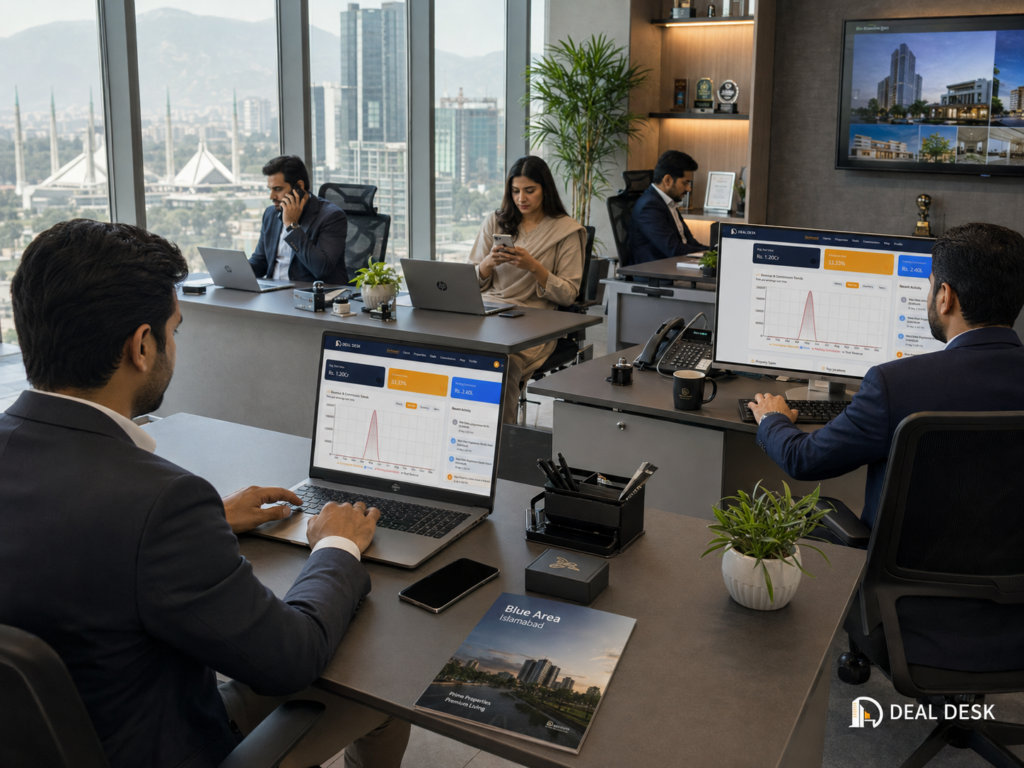
Practical takeaways
If you want your real estate business to stay competitive in the coming years:
- Build systems before expanding your team.
- Centralize all client and property information.
- Replace manual processes with structured workflows.
- Use data to guide business decisions.
- Invest in technology that improves efficiency and client experience.
- Focus on long-term scalability rather than short-term survival.
Final thought
The future of real estate in Pakistan will not belong solely to the agencies with the most listings or the largest advertising budgets.
It will belong to the agencies that are the most organized.
As competition increases and client expectations continue to rise, success will depend on how efficiently you manage your business behind the scenes.
The question is no longer whether technology and systems are necessary.
The real question is whether your agency is prepared for the future.
Because in the years ahead, the gap between agencies that rely on systems and those that rely on manual processes will continue to grow.
And that gap may determine who leads the market—and who struggles to keep up.