

Most real estate agents do not lose deals because they lack experience.
They lose deals because they struggle to manage opportunities consistently.
A lead comes in.
A conversation starts.
Properties are shared.
Interest is shown.
And then something happens.
A follow-up gets delayed.
A client message gets buried under dozens of other chats.
A site visit is not tracked properly.
A serious buyer slowly loses interest.
The opportunity disappears.
This is a common reality for many real estate professionals.
The issue is rarely effort.
The issue is the absence of a system.
Why closing deals becomes difficult as your business grows
When you are handling only a few clients, managing deals manually feels manageable.
You can remember conversations.
You know who needs a follow-up.
You can track progress mentally.
But growth changes everything.
As more leads enter your business:
- Conversations increase
- Follow-ups multiply
- Property listings expand
- Negotiations overlap
- Client expectations grow
Suddenly, managing deals becomes much more complex.
Without structure, opportunities begin slipping through the cracks.
The biggest reason deals don’t close
Many agents focus heavily on generating leads.
While lead generation is important, it is only the beginning of the sales process.
The real challenge is moving leads through the journey successfully.
A typical deal requires:
- Consistent communication
- Timely follow-ups
- Accurate information
- Clear tracking
- Proper organization
When any of these areas break down, the chances of closing decrease significantly.
This is why many agents remain busy but struggle to improve their conversion rates.
What a Real Estate CRM actually does
A Real Estate CRM is much more than a contact database.
It is a complete system for managing leads, clients, properties, and deals.
Instead of relying on memory and scattered tools, a CRM creates a structured workflow.
It helps agents:
- Organize client information
- Track every deal stage
- Schedule follow-ups
- Record interactions
- Monitor performance
The result is greater visibility and control.
And visibility is what improves decision-making.
How a CRM helps close more deals
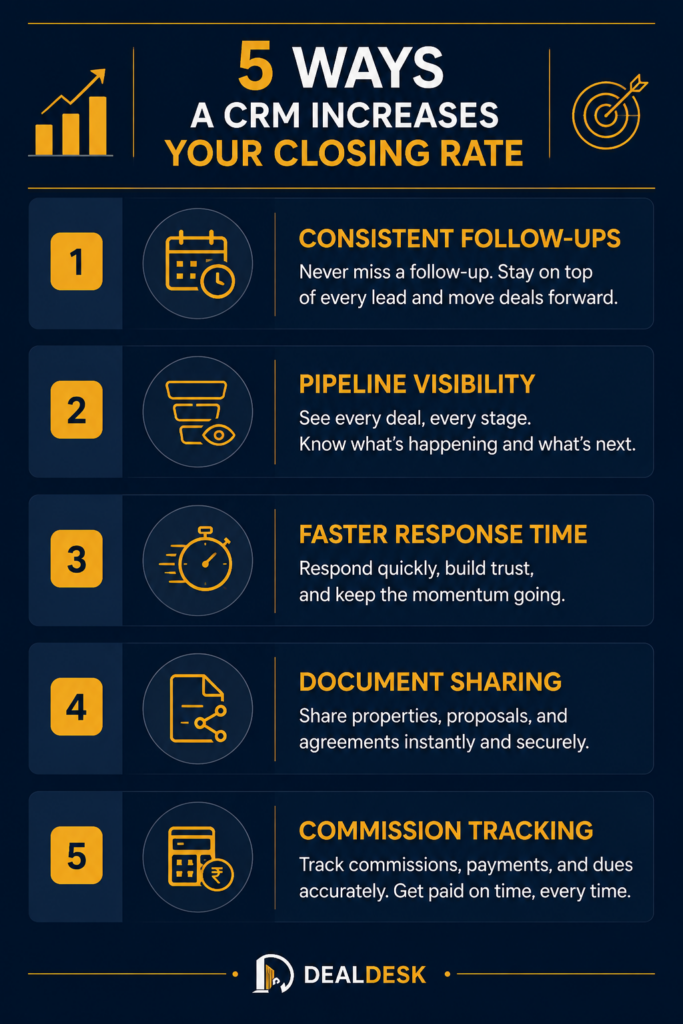
1. No lead gets forgotten
One of the biggest reasons deals are lost is poor lead tracking.
A CRM keeps every lead organized in one place.
You can instantly see:
- New inquiries
- Active opportunities
- Follow-up schedules
- Deal progress
This reduces the risk of losing leads simply because they were forgotten.
2. Follow-ups become consistent
In real estate, timing matters.
The agent who follows up consistently often wins the deal.
A CRM helps schedule reminders and track communication history.
Instead of relying on memory, agents can follow a structured process.
This improves client engagement and increases trust.
3. Better visibility into deal progress
Without a system, many agents do not know exactly where their deals stand.
A CRM solves this by creating a visual sales pipeline.
You can track deals through stages such as:
- New Lead
- Contacted
- Property Shared
- Site Visit
- Negotiation
- Closed
This clarity helps agents prioritize opportunities effectively.
4. Faster response times
Clients expect quick responses.
When information is organized and accessible, agents can respond faster and more accurately.
This improves the client experience and creates a competitive advantage.
In many cases, the fastest and most organized agent wins the business.
5. Better client relationships
Clients appreciate professionalism.
When agents remember preferences, previous discussions, and follow-up commitments, trust increases.
A CRM stores all this information in one place.
This allows agents to deliver a more personalized experience.
And stronger relationships often lead to more closed deals.

Why top-performing agencies rely on systems
Successful agencies understand that growth cannot depend on memory.
As business expands, systems become essential.
A CRM creates:
- Consistency
- Accountability
- Visibility
- Scalability
These advantages allow agencies to manage more opportunities without creating more chaos.
That is why many high-performing real estate businesses invest in structured workflows instead of relying on manual processes.
Where DealDesk fits into this
This is where platforms like DealDesk help real estate professionals improve their deal management process.
DealDesk is designed specifically for property dealers and real estate agencies.
It helps users:
- Manage leads centrally
- Track deals visually
- Schedule follow-ups
- Share properties efficiently
- Monitor commissions and activities
Instead of juggling multiple tools, agents can manage their entire workflow from one platform.
The result is greater organization and higher conversion potential.
Practical takeaways
If you want to close more real estate deals:
- Track every lead from the first inquiry
- Create a structured sales pipeline
- Follow up consistently
- Centralize all client information
- Use systems instead of memory
Small improvements in organization often create significant improvements in results.
Final thought
Closing more deals is not always about finding more leads.
Often, it is about managing existing opportunities more effectively.
Because the agents who stay organized, follow up consistently, and maintain visibility over their pipeline are the ones who convert more leads into clients.
If you are serious about growing your real estate business, implementing a Real Estate CRM may be one of the most impactful decisions you can make.
The right system does not just organize your work.
It helps you close more deals.