
A real estate deal rarely happens in one conversation.
It can involve dozens of calls, property visits, negotiations, documents, price changes, client requests, and follow-ups before the transaction is finally closed.
Yet many real estate teams record only the final outcome.
Deal closed.
But what happened before that?
Who spoke to the client?
Which property was shared?
What price was discussed?
When was the last follow-up?
What did the client agree to?
Which documents were received?
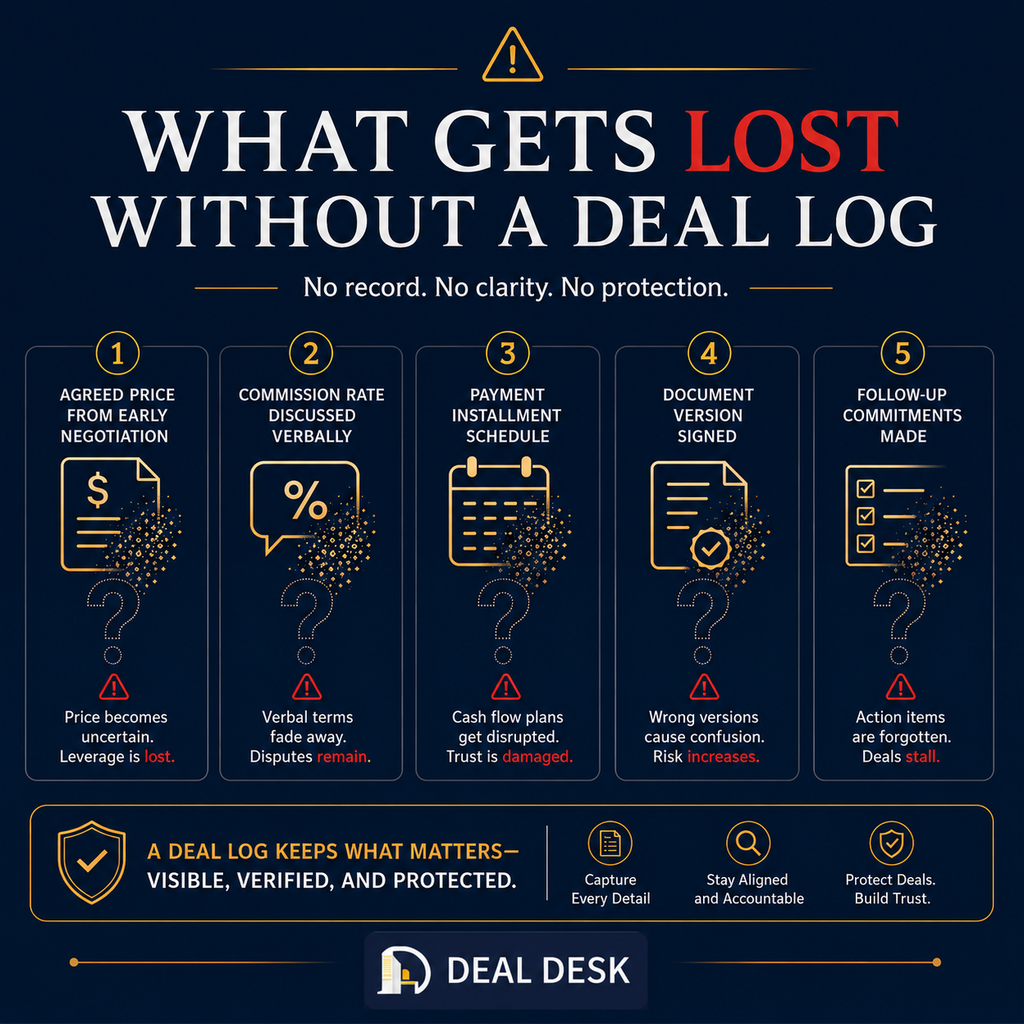
Without a proper record, important details disappear.
And when they disappear, your team starts relying on memory.
That is where problems begin.
A deal is more than its final status
A deal should not simply be marked as:
Active → Closed
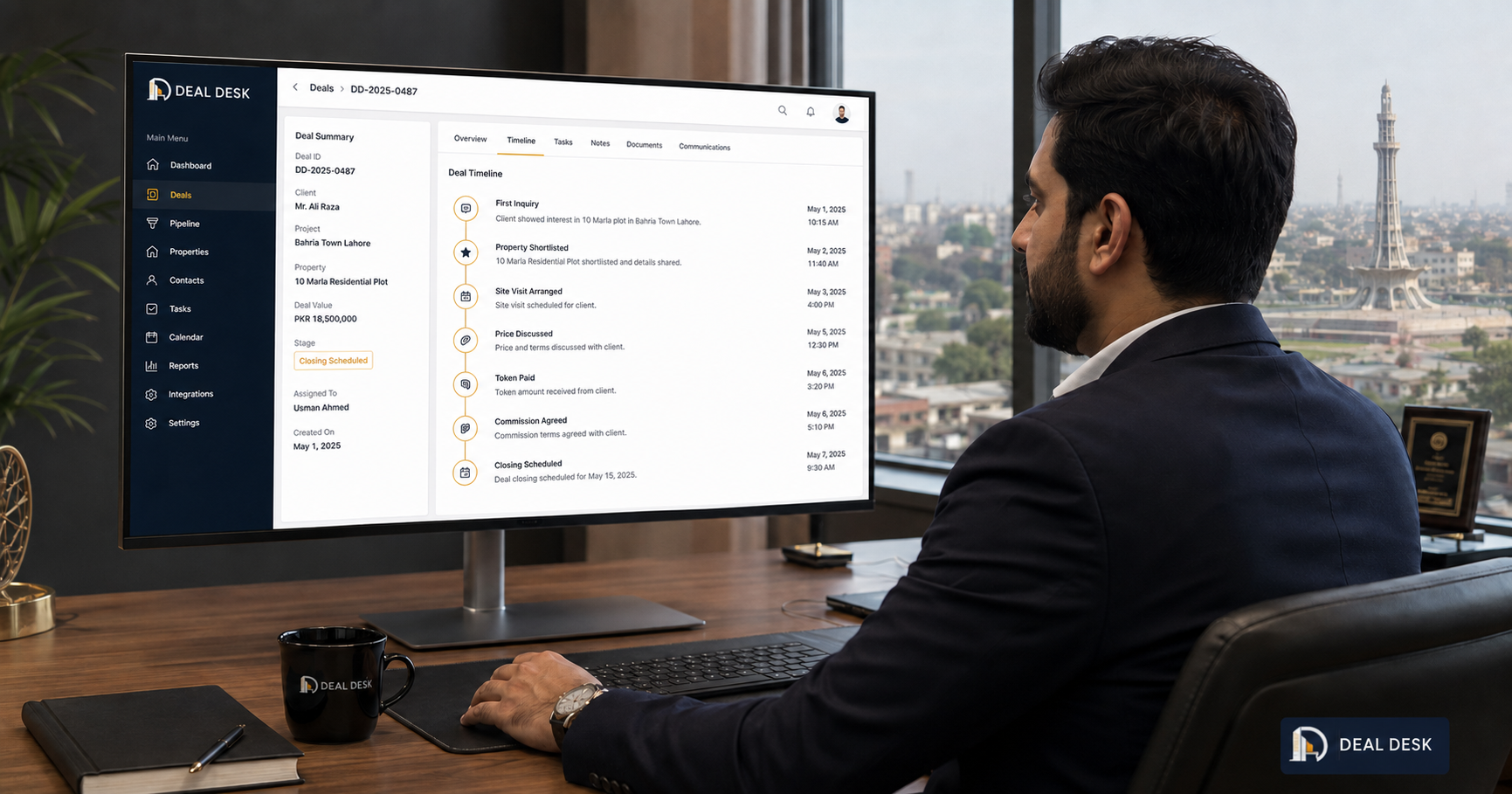
There is a complete history behind every successful transaction.
For example:
Lead received → Client contacted → Requirements recorded → Properties shared → Site visit → Negotiation → Price revised → Documents exchanged → Deal closed
Every step provides valuable information.
When that history is properly recorded, anyone on the team can understand exactly what happened.
Without it, the business loses context.
What happens when you don’t log deal activity?
Imagine an agent is handling a client who has been negotiating for several weeks.
The client calls again and asks:
“What was the final price we discussed?”
The agent checks WhatsApp.
There are hundreds of messages.
They search through old conversations.
They find three different prices.
Now nobody is completely sure which one was agreed upon.
This may sound like a small issue.
But situations like this happen every day in real estate.
When deal activity is not logged properly, teams face:
- Confusion between agents
- Repeated conversations
- Missed commitments
- Incorrect information
- Delayed decisions
- Difficult handovers
- Disputes over deal history
A missing record can create a much bigger problem later.
Deal history creates accountability
A structured deal history answers an important question:
What actually happened?
When every major action is recorded, there is a clear timeline.
You can see:
- When the lead entered the system
- Who was assigned to the client
- Which properties were shared
- When meetings happened
- What stage the deal reached
- When negotiations took place
- Which documents were added
- When the deal was closed
This creates accountability without requiring managers to constantly ask their team for updates.
It also makes team collaboration easier
Real estate deals are not always handled by one person.
An agent may be unavailable.
A manager may need to take over.
Another team member may need to assist the client.
Without deal history, the new person has to start from the beginning.
They may ask the client questions they have already answered.
They may share properties that were already rejected.
They may repeat negotiations that already happened.
That creates a poor client experience.
With a complete deal history, the next team member can immediately understand the situation and continue from where the previous agent stopped.
Logging every step improves client service
Clients don’t want to repeatedly explain themselves.
If a buyer already told your team:
“I need a property in this location within this budget.”
Your team should remember it.
If they already rejected five properties, those same properties should not keep appearing in their recommendations.
A detailed activity history helps agents understand the client’s journey.
That leads to more relevant communication and a more professional experience.
Deal history protects your business
Documentation is not only about convenience.
It can also protect the agency.
Real estate transactions can involve sensitive information, financial discussions, agreements, and important commitments.
A properly maintained history provides a record of how the transaction progressed.
Instead of relying on:
“I think we discussed that.”
you have:
“Here is what was recorded.”
That difference becomes extremely valuable when questions arise.
Your CRM should tell the complete story
A good Real Estate CRM should not only show the current stage of a deal.
It should provide context.
For example:
Current Status: Negotiation
Last Activity: Client meeting
Previous Activity: Property visit
Properties Shared: 4
Follow-Up: Scheduled
Documents: Added
This gives managers and agents an immediate understanding of what is happening.
No searching through multiple applications.
No guessing.
No relying on memory.
From individual memory to business knowledge
One of the biggest problems in growing real estate agencies is that important knowledge often lives inside individual employees.
An agent knows the client.
Another agent knows the property.
The manager knows the negotiation.
Someone else has the documents.
This creates dependency.
When information is properly logged, knowledge becomes part of the business rather than belonging to one individual.
That makes the agency more resilient and easier to scale.
Where DealDesk fits in
DealDesk helps real estate agencies bring their clients, properties, deals, documents, commissions, and workflows into one centralized platform.
Instead of allowing important deal information to remain scattered across WhatsApp conversations, spreadsheets, notebooks, and personal devices, your team can maintain a structured record of the transaction.
This helps your team understand:
- What happened
- Who handled it
- What needs to happen next
- Where the deal currently stands
The result is better visibility and more consistent operations.
Don’t just track the deal. Track the journey.
The final status of a transaction tells you what happened.
The complete activity history tells you why it happened.
That information can help you identify:
- Where deals are getting delayed
- Which stages create bottlenecks
- Where leads are being lost
- Which agents need support
- Which processes can be improved
This turns deal history into a source of business intelligence.
You are no longer simply recording transactions.
You are learning from them.

Practical takeaways
If your agency does not currently log deal activity consistently, start with the basics:
- Record every major client interaction.
- Track property sharing and client responses.
- Record important negotiation updates.
- Keep documents connected to the relevant deal.
- Maintain a clear deal timeline.
- Record follow-ups and next actions.
- Make deal history accessible to the appropriate team members.
The goal is not to record every meaningless conversation.
The goal is to make sure important business decisions and activities never disappear.
Final Thought
A closed deal tells you that you won.
It does not tell you how you got there.
The real value is in the journey.
Every property shared.
Every follow-up.
Every negotiation.
Every client decision.
Every document.
Every important change.
When these steps are logged, your agency builds a record of its own experience.
When they are not, valuable information disappears the moment a conversation is forgotten.
Don’t let your business depend on memory.
Build a system where every important deal has a clear history, every team member has the right context, and every transaction becomes part of your organization’s knowledge.
Ready to bring your real estate deals, clients, properties, documents, and commissions into one organized system?
Turn every deal into a trackable, measurable business process with DealDesk.