

One of the biggest challenges in real estate is not finding deals.
It is managing multiple deals at the same time.
When you are handling one or two clients, everything feels under control. You remember conversations, property preferences, follow-ups, and next steps without much effort.
But as your business grows, things start to change.
You may be dealing with:
- Multiple buyers looking for different properties
- Several sellers expecting updates
- Ongoing negotiations
- Site visits scheduled throughout the week
- New leads arriving every day
Suddenly, keeping track of everything becomes difficult.
And this is where confusion begins.
Why managing multiple property deals becomes difficult
Real estate transactions involve many moving parts.
Each client has unique requirements.
Each property has different details.
Each deal moves at its own pace.
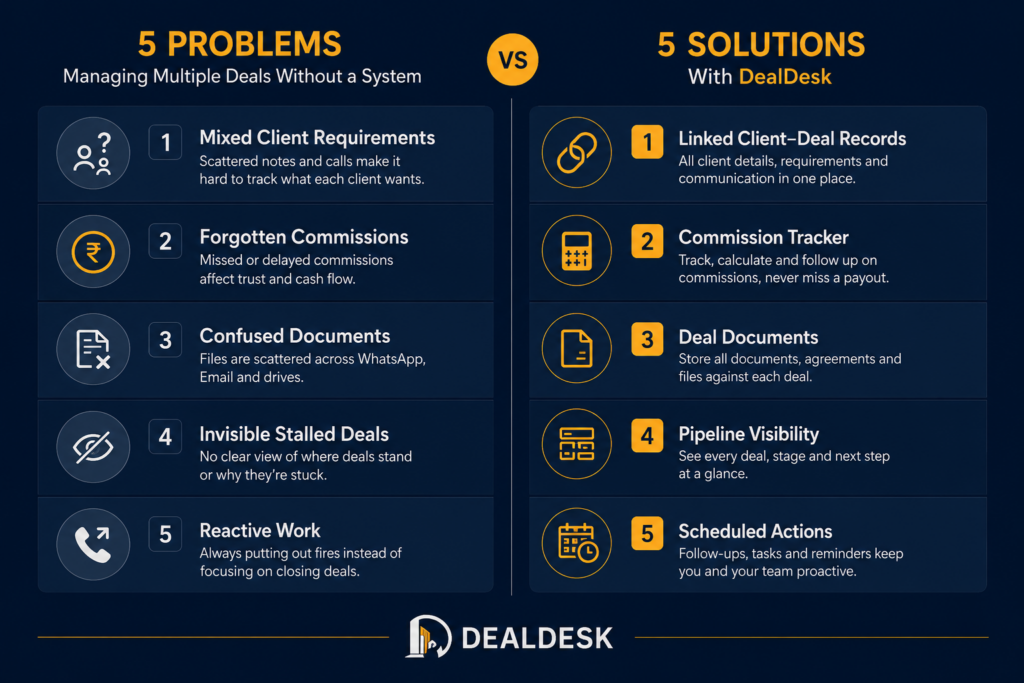
Without a structured process, information becomes scattered across:
- WhatsApp conversations
- Phone calls
- Excel sheets
- Notes and reminders
- Personal memory
At first, it may seem manageable.
But eventually, details start slipping through the cracks.
A follow-up gets missed.
A client receives the wrong property information.
A negotiation update is forgotten.
And opportunities begin disappearing.
The hidden cost of confusion
Many agents assume occasional mistakes are normal.
The reality is that confusion is expensive.
When deals are not managed properly:
- Clients lose confidence
- Follow-ups become inconsistent
- Response times increase
- Opportunities are delayed
- Revenue is lost
The biggest problem is that these losses often happen quietly.
A client simply stops responding.
A deal suddenly goes cold.
A prospect chooses another agent.
And the root cause is often poor organization.
Why hard work alone is not enough
Many agents try to solve this problem by working longer hours.
They spend more time checking messages, reviewing notes, and searching for information.
But more effort does not solve a broken process.
In fact, as the number of deals increases, relying on memory becomes even more risky.
The solution is not working harder.
The solution is creating a system that can handle growth.
Step 1: Centralize all deal information
The first step is ensuring every deal is tracked in one place.
For each client, you should know:
- Contact information
- Property requirements
- Properties shared
- Current deal stage
- Follow-up history
- Next action required
When information is centralized, visibility improves immediately.
Instead of searching through multiple platforms, everything becomes accessible and organized.
Step 2: Create a clear deal pipeline
A structured pipeline helps agents understand where every deal stands.
For example:
- New Lead
- Contacted
- Property Shared
- Site Visit Scheduled
- Negotiation
- Closed
- Lost
This simple structure creates clarity.
You can instantly see which deals are progressing and which ones need attention.
Without a pipeline, opportunities often get lost between conversations.
Step 3: Schedule every follow-up
One of the most common reasons deals stall is missed follow-ups.
Every active deal should have a next action.
After every conversation, ask:
“What happens next?”
The answer should always be documented and scheduled.
This prevents opportunities from going cold and keeps momentum moving forward.
Step 4: Track client interactions
Successful agents do not rely on memory.
They document conversations.
This helps them remember:
- Client preferences
- Budget discussions
- Objections
- Property feedback
- Negotiation details
When information is recorded properly, future conversations become more productive and professional.
Step 5: Prioritize active opportunities
Not all deals require the same level of attention.
Some clients are ready to move quickly.
Others may need more time.
A structured process helps identify:
- High-priority opportunities
- Deals at risk
- Clients requiring immediate follow-up
- Opportunities closest to closing
This allows agents to focus their energy where it creates the greatest impact.

How a Real Estate CRM simplifies deal management
Managing multiple property deals manually becomes increasingly difficult as business grows.
This is why many professionals use a real estate CRM.
A CRM helps agents:
- Track every deal in one place
- Organize client information
- Manage follow-ups automatically
- Monitor deal progress
- Maintain visibility across the entire sales pipeline
Instead of reacting to daily chaos, agents gain control over their workflow.
Where DealDesk helps
Platforms like DealDesk are built specifically for real estate professionals who manage multiple clients, properties, and transactions simultaneously.
DealDesk helps agents:
- Track all active deals from a single dashboard
- Organize client and property information
- Monitor deal stages visually
- Schedule follow-ups
- Maintain complete business visibility
The result is less confusion, better organization, and improved conversion rates.
Practical takeaways
If you want to manage multiple property deals more effectively:
- Centralize all deal information
- Create a clear sales pipeline
- Schedule every follow-up
- Track client interactions consistently
- Prioritize active opportunities regularly
Small improvements in organization can create significant improvements in performance.
Final thought
The most successful real estate agents are not necessarily the busiest.
They are the most organized.
Because when you can clearly see every deal, every client, and every next step, you make better decisions and create better outcomes.
If your business is growing and deal management is becoming overwhelming, it may be time to move from scattered processes to a structured system.
Because the more deals you manage, the more valuable organization becomes.