

In real estate, a single deal can involve dozens of important documents.
Property ownership records.
Agreements.
Client information.
Payment records.
Contracts.
Identity documents.
And sometimes, the entire history of a transaction.
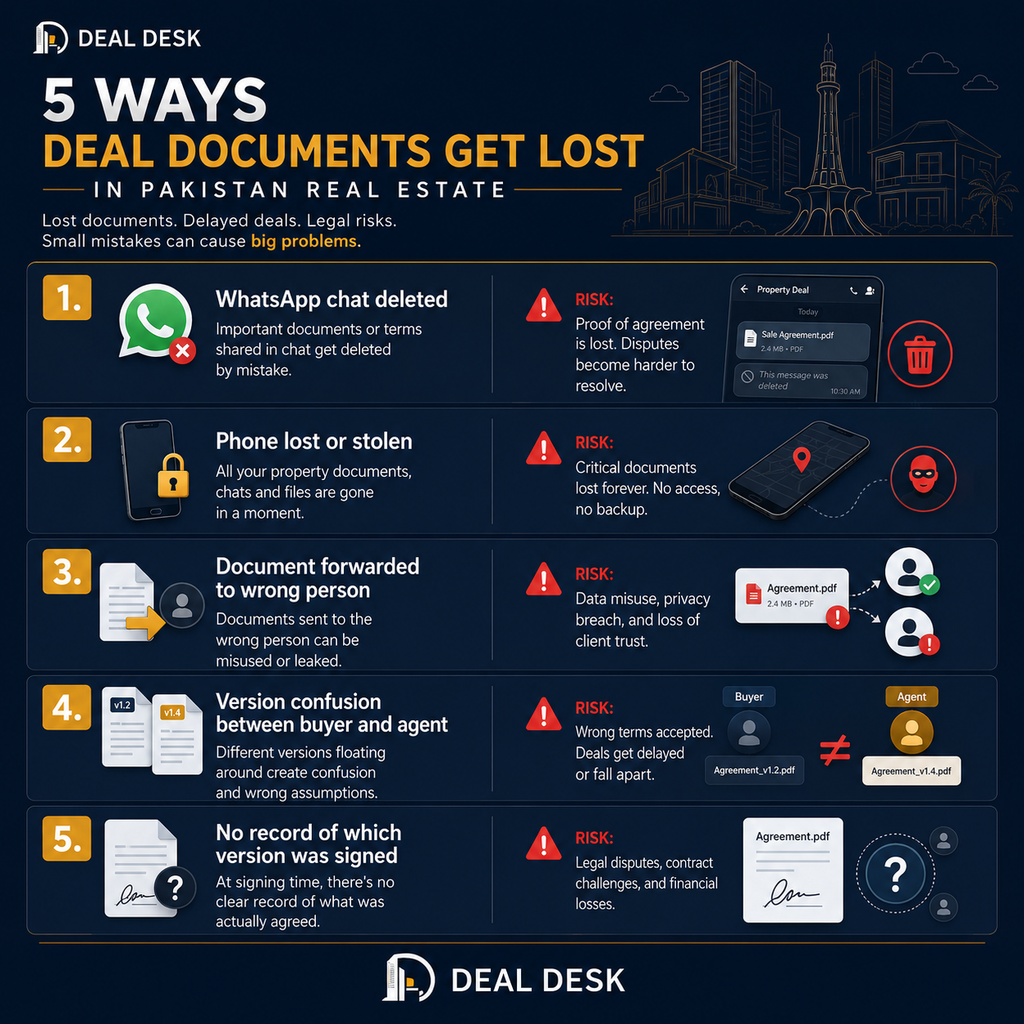
Yet many real estate professionals still store these documents on their phones.
It feels convenient.
The document is always nearby. WhatsApp makes it easy to receive and send files. Your phone is always with you.
But convenience can quickly become a business risk.
Because your phone was never designed to be your real estate document management system.
Your phone is not a secure business archive
Imagine losing your phone tomorrow.
Or accidentally deleting an important conversation.
Or having your phone damaged.
Or changing your device and realizing that some files were never backed up.
Suddenly, documents that seemed safely stored are no longer easily accessible.
For an individual, this can be frustrating.
For a real estate agency, it can become a serious operational problem.
Important business information should not depend on a single device.
WhatsApp is useful, but it is not document management
WhatsApp is an excellent communication tool.
Real estate agents use it every day to communicate with:
- Buyers
- Sellers
- Dealers
- Property owners
- Team members
But conversations are not the same as organized business records.
When documents are buried inside hundreds of messages, finding the correct file can take time.
You may have to scroll through an old conversation just to locate a property document you received months ago.
And even worse, you may not know whether the file you found is the latest version.
That creates unnecessary risk.
What happens when documents are scattered?
As an agency grows, document chaos grows with it.
One agent may have documents on their phone.
Another may have files on their laptop.
Someone else may have them in Google Drive.
Some documents may still be sitting inside WhatsApp conversations.
There is no single source of truth.
This creates problems such as:
- Duplicate documents
- Missing files
- Outdated versions
- Difficult document retrieval
- Poor team collaboration
- Accidental deletion
- Unclear access
The more people involved in a transaction, the more important centralized document management becomes.
Real estate deals require organized documentation
A professional real estate operation should be able to answer simple questions quickly.
Where is the agreement for this deal?
Which documents belong to this client?
What documents have already been shared?
Which version is the latest?
Can the responsible agent access everything they need?
If answering these questions requires searching through multiple phones and WhatsApp conversations, your business has a process problem.
A good system should make these answers immediately accessible.
The risk becomes bigger as your team grows
Imagine an agent leaves your agency.
What happens to the documents stored on their phone?
What happens to client conversations?
What happens to property files?
What happens to documents that were never transferred to another team member?
If important business information lives inside employees’ personal devices, the business can lose visibility when people leave.
A scalable real estate agency should own its business information.
Not individual employees.
Centralized document management changes everything
Instead of storing documents across different devices, create a centralized system where documents are connected to the relevant:
- Client
- Property
- Deal
- Transaction
This makes information easier to find and easier to manage.
An agent should not need to ask another employee:
“Can you send me that document again?”
They should be able to access the relevant record and find it immediately.
That is what proper real estate document management should accomplish.
Security is only one part of the problem
People often think document security simply means protecting files from unauthorized access.
But business continuity is equally important.
A proper document management system should help protect against:
- Device loss
- Accidental deletion
- Employee turnover
- Scattered records
- Duplicate files
- Poor organization
The goal is not simply to keep documents safe.
The goal is to make sure your business can continue operating even when something goes wrong.
How a Real Estate CRM can help
A modern Real Estate CRM can connect documents directly to the business records they belong to.
Instead of having:
Client → WhatsApp → Search messages → Find document
you can have:
Client → Deal → Documents
This creates a much cleaner workflow.
Your team can access relevant information without searching through personal devices or endless conversations.
Where DealDesk fits into this
DealDesk is designed to help real estate agencies manage their business from one centralized platform.
Instead of relying on phones and scattered conversations, teams can organize their:
- Clients
- Properties
- Deals
- Documents
- Commissions
- Follow-ups
Documents can remain connected to the relevant business workflow, making it easier for authorized team members to access the information they need.
This becomes especially valuable when multiple agents are working on the same transactions.
The goal is simple:
Your business information should belong to your business, not someone’s phone.
A better document workflow
A professional real estate agency can follow a simple process:
1. Receive
A document is received from the client, owner, or dealer.
2. Organize
It is attached to the appropriate client, property, or deal.
3. Store
The document is kept in the agency’s centralized system.
4. Access
Authorized team members can retrieve it when required.
5. Share
The relevant document can be shared with the appropriate client or stakeholder.
This eliminates unnecessary searching and reduces dependence on individual devices.

Practical takeaways
If your agency currently stores important deal documents on personal phones, consider changing the process.
- Stop treating WhatsApp as your document archive.
- Centralize important transaction records.
- Connect documents to clients and deals.
- Control who can access sensitive business information.
- Make documents accessible to the right team members.
- Build a process that does not depend on one employee’s phone.
The objective is not to eliminate convenient communication tools.
It is to make sure they are not responsible for storing your entire business history.
Final Thought
Your phone is replaceable.
Your WhatsApp conversation can disappear.
A device can be lost, damaged, or compromised.
But the information inside a real estate deal can be extremely difficult to replace.
That is why professional agencies need to think beyond convenience.
Your documents are part of your business infrastructure.
Treat them like it.
Do not let your next deal depend on finding the right file inside someone’s phone.
Build a centralized system where your clients, properties, deals, documents, and commissions are organized and accessible when your team needs them.
Ready to move your real estate operations beyond scattered phones and WhatsApp conversations?
Build a more organized real estate business with DealDesk.