
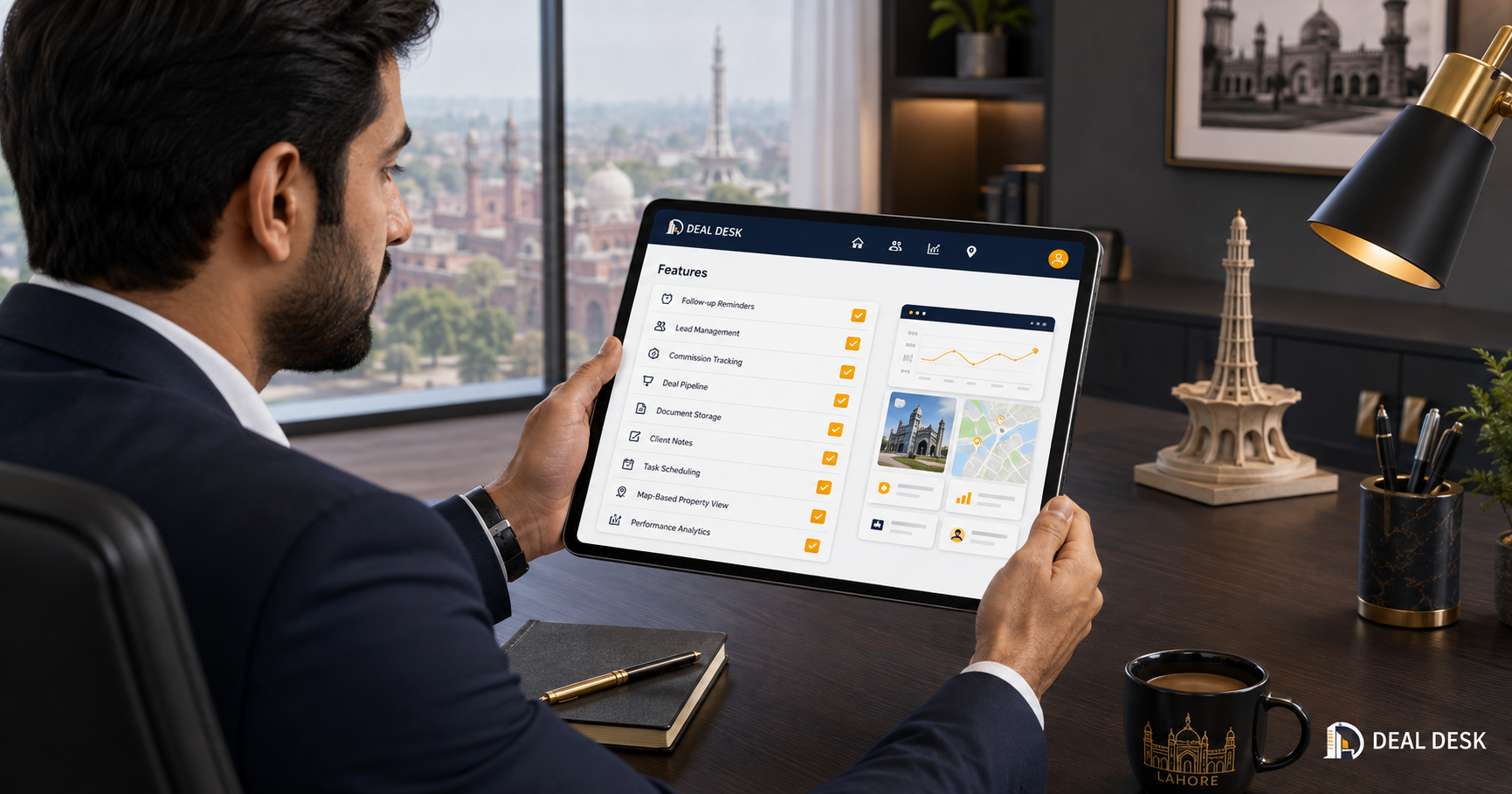
Choosing a CRM for your real estate business is not just about buying software.
It is about investing in a system that will support your agency as it grows.
Many real estate professionals start with spreadsheets, notebooks, and messaging apps because they seem simple and inexpensive.
But as more leads, clients, and properties enter the business, those manual methods become difficult to manage.
That is when many agencies begin searching for a Real Estate CRM.
The challenge is that not every CRM is built for the real estate industry.
Some focus only on contact management.
Others offer generic sales tools that do not match the day-to-day workflow of property dealers.
The right CRM should help you organize your entire business—not just store customer information.
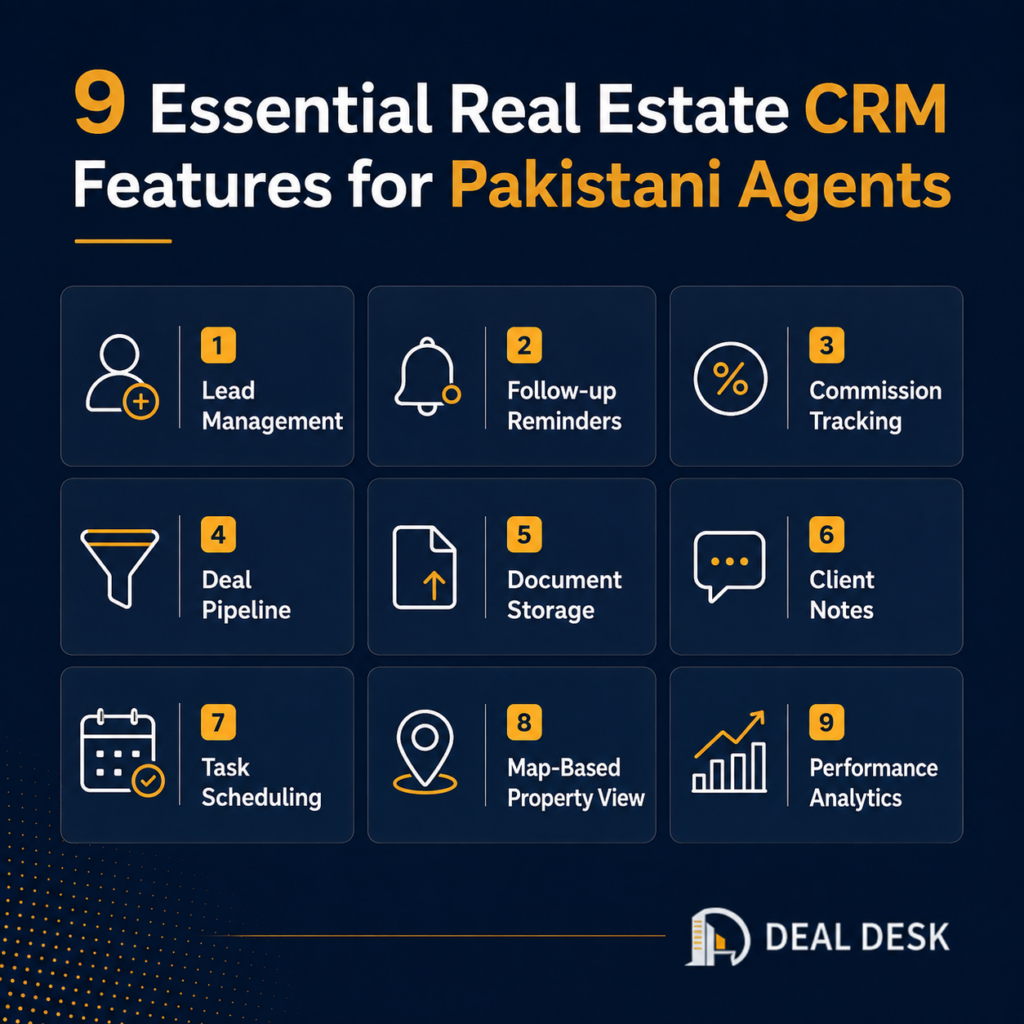
Here are the most important features every real estate agency should look for.
1. Lead Management
Every deal begins with a lead.
Your CRM should capture and organize leads from multiple sources, including:
- Website inquiries
- Facebook Lead Ads
- WhatsApp inquiries
- Referral clients
- Manual entries
Instead of losing track of inquiries, every lead should automatically enter your sales pipeline.
This ensures that no opportunity is forgotten.
2. Client Management
A CRM should provide a complete profile for every client.
This should include:
- Contact information
- Property preferences
- Budget
- Communication history
- Shared properties
- Documents
- Notes
- Current deal status
Having all client information in one place improves communication and allows every team member to deliver a consistent experience.
3. Property Management
A Real Estate CRM should be built around properties.
You should be able to:
- Add new listings
- Upload property images
- Record pricing
- Track availability
- Categorize properties
- Search listings instantly
The faster you can match properties with client requirements, the better your service becomes.
4. Visual Deal Pipeline
One of the most valuable CRM features is a visual sales pipeline.
Instead of wondering where deals stand, you should immediately see stages such as:
- New Lead
- Contacted
- Property Shared
- Site Visit
- Negotiation
- Closed
- Lost
This provides complete visibility across your business.
Managers know which deals require attention without asking for constant updates.
5. Follow-Up Reminders
Many real estate deals are lost because agents simply forget to follow up.
Your CRM should automatically remind you about:
- Scheduled calls
- Client meetings
- Site visits
- Document requests
- Negotiation updates
Follow-ups should never depend on memory.
Automation creates consistency.
6. Document Management
Real estate transactions involve many important documents.
A CRM should allow you to securely store:
- Property documents
- Agreements
- Client identification
- Contracts
- Payment records
Having documents attached directly to clients and deals saves time and reduces confusion.
7. Commission Tracking
Managing commissions manually becomes difficult as the number of deals grows.
Look for a CRM that allows you to:
- Track expected commissions
- Record received payments
- Manage commission splits
- Monitor team earnings
- Generate commission reports
Financial visibility is just as important as deal visibility.
8. Team Collaboration
If multiple agents work together, collaboration becomes essential.
A good CRM should allow managers to:
- Assign leads
- Monitor team activities
- Track performance
- Share notes
- View deal progress
This reduces duplicate work and improves accountability.
9. Reporting and Analytics
You cannot improve what you do not measure.
A CRM should provide reports such as:
- Lead sources
- Conversion rates
- Active deals
- Closed deals
- Agent performance
- Commission reports
- Monthly revenue
These insights help agency owners make better business decisions.
10. Property Sharing
Sharing listings is a daily task for every real estate professional.
Your CRM should make it easy to:
- Share properties with clients
- Share listings with partner dealers
- Send preferred property collections
- Track which properties have already been shared
This improves communication while saving valuable time.
11. Mobile Accessibility
Real estate professionals spend much of their day outside the office.
Whether meeting clients or visiting properties, they need access to business information anywhere.
A CRM that works well on mobile devices allows agents to:
- Update deals
- Respond to leads
- Access client information
- Schedule follow-ups
This keeps the business moving even when the team is away from their desks.
Why choosing the right CRM matters
The right CRM does more than organize data.
It improves the way your agency operates.
Instead of spending time searching for information, your team spends more time serving clients.
Instead of missing follow-ups, every opportunity is tracked.
Instead of relying on memory, every process becomes structured.
That leads to higher productivity, better client experiences, and increased profitability.
Where DealDesk stands out
DealDesk was designed specifically for real estate professionals, which means its features are built around the actual workflow of property dealers and agencies.
With DealDesk, you can:
- Capture and manage leads from multiple sources
- Organize clients and property listings
- Track deals through a visual sales pipeline
- Schedule follow-ups automatically
- Share properties with clients and partner dealers
- Manage commissions
- Store important documents securely
- Monitor team performance from a centralized dashboard
Rather than using multiple disconnected tools, DealDesk brings your entire business into one platform.

Practical takeaways
When evaluating a Real Estate CRM, ask these questions:
- Does it organize leads effectively?
- Can it manage both clients and properties?
- Does it provide a visual sales pipeline?
- Are follow-ups automated?
- Can it track commissions?
- Does it improve team collaboration?
- Does it provide useful business reports?
- Will it support your agency as it grows?
Choosing the right CRM is not just about today’s needs.
It is about preparing your business for tomorrow.
Final thought
Technology alone will not make a real estate agency successful.
But the right technology can remove the daily obstacles that slow your team down.
The best real estate agencies use CRMs not because they want more software, but because they want better organization, stronger client relationships, and greater visibility across their business.
If your goal is to build a scalable, profitable agency, choosing a CRM with the right features is one of the smartest investments you can make.