

Most real estate agencies know exactly how much commission they made from a closed deal.
Far fewer know how much they spent getting there.
That is a problem.
Because a lead is not free just because it did not require a direct payment to acquire.
Every lead consumes resources.
An agent spends time calling.
Someone sends property details.
Follow-ups are made.
Site visits are arranged.
Transportation may be involved.
Documents are prepared.
Managers spend time monitoring the process.
And sometimes, after all that effort, the lead goes nowhere.
The real cost is not just the money you spent.
It is the opportunity you lost by spending your resources on the wrong lead.
Bad leads have a hidden cost
Imagine your agency receives 100 leads from a marketing campaign.
Your team contacts all 100.
Out of those, 30 show some interest.
Ten request property details.
Five schedule site visits.
One eventually becomes a deal.
At first glance, you may look at the one closed deal and calculate the commission.
But what about the 99 leads that did not convert?
How much agent time was spent on them?
How many calls were made?
How many follow-ups were completed?
How many site visits were arranged?
Without tracking this information, you cannot accurately understand the profitability of your marketing and sales process.
The most expensive resource is often time
Real estate agencies frequently focus on advertising costs.
But agent time can be just as valuable.
If an agent spends hours repeatedly following up with someone who has no genuine buying intention, those hours cannot be recovered.
During that same time, another qualified client may be waiting for a response.
This creates an important principle:
A bad lead does not just waste money. It consumes capacity.
And limited capacity means fewer opportunities for better leads.
Not every lead deserves the same attention
One of the biggest mistakes real estate teams make is treating every lead equally.
A person who is ready to purchase within 30 days should not necessarily receive the same priority as someone casually browsing properties with no defined budget or timeline.
Your team needs a way to identify lead quality.
For example, leads can be categorized based on:
- Budget
- Location
- Property requirement
- Buying timeline
- Level of interest
- Previous interactions
- Follow-up history
This allows agents to focus their time where it has the highest potential return.

Your marketing data should tell you more than lead volume
Getting thousands of leads sounds impressive.
But lead quantity alone does not determine marketing success.
Consider two campaigns.
Campaign A
1,000 leads
20 qualified leads
2 closed deals
Campaign B
200 leads
40 qualified leads
8 closed deals
Which campaign performed better?
Clearly, the second one.
This is why real estate businesses need to look beyond lead volume and measure the complete journey from lead generation to conversion.
Track the cost of every opportunity
A good real estate CRM should help your agency understand what happens after a lead enters the business.
You should be able to track:
Lead Source → Lead Assignment → Contact Attempt → Qualification → Follow-Up → Site Visit → Negotiation → Deal
Once this information is available, you can start identifying patterns.
Maybe Facebook generates a large number of leads but a low conversion rate.
Maybe referrals generate fewer leads but significantly more closed deals.
Maybe one project produces excellent leads while another consumes your team’s time without generating results.
Without tracking, these differences remain hidden.
Stop measuring agents only by activity
Calling 100 leads sounds productive.
But activity does not always equal performance.
An agent who makes 100 calls and closes nothing may appear more active than someone who makes 30 highly targeted calls and closes three deals.
This is why agencies should measure both activity and outcomes.
Useful metrics include:
- Leads assigned
- Contact rate
- Qualified leads
- Follow-ups completed
- Site visits booked
- Deals closed
- Conversion rate
- Commission generated
These metrics provide a much clearer picture of performance.
Bad leads can also damage your team
There is another cost that rarely appears in a spreadsheet.
Frustration.
When agents spend their entire day chasing unqualified prospects, motivation can decline.
They feel busy but see little progress.
Over time, this can affect productivity and team morale.
Better lead qualification allows your agents to spend more time with people who have genuine potential.
That creates a healthier and more productive sales environment.
The solution is not simply generating fewer leads
The answer is not to stop marketing.
It is to become smarter about the leads you generate.
Your agency should continuously ask:
Where are our best leads coming from?
Which sources produce actual deals?
Which campaigns generate unqualified inquiries?
How much time are agents spending on each lead?
Which lead characteristics correlate with successful transactions?
The answers can help you improve both marketing and sales efficiency.
Where DealDesk fits in
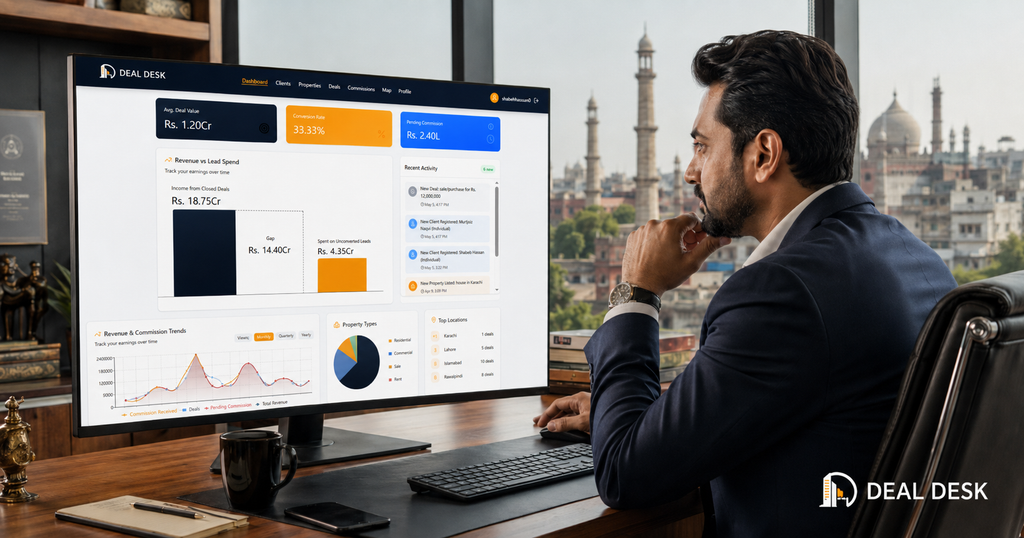
DealDesk helps real estate businesses bring their leads, clients, properties, deals, and commissions into one centralized workflow.
Instead of simply counting incoming leads, your team can track what happens to them after they enter the business.
For agencies, this becomes especially valuable when leads are assigned to multiple agents and managers need visibility into performance.
You can see which leads are being worked, how agents are progressing with them, and how leads eventually move toward deals.
That creates a connection between lead generation, sales activity, and revenue.
And that is where real estate data becomes genuinely useful.
Turn your lead data into business intelligence
The goal is not to eliminate every bad lead.
That is impossible.
The goal is to understand them.
If a particular source consistently produces low-quality leads, you can reconsider your marketing strategy.
If another source generates fewer but higher-converting clients, you can allocate more resources toward it.
If a particular agent converts qualified leads significantly better than others, you can identify what they are doing differently.
Data allows you to make these decisions based on evidence instead of assumptions.
Practical takeaways
If your agency wants to reduce the hidden cost of bad leads:
- Track every lead from source to outcome.
- Measure qualified leads instead of only total leads.
- Record follow-ups and agent activity.
- Track site visits and conversion rates.
- Compare lead sources based on closed deals and revenue.
- Identify which leads deserve higher priority.
- Measure the time your team spends chasing opportunities.
- Use a centralized CRM to connect lead activity with actual business results.
The objective is simple:
Spend less time chasing the wrong opportunities and more time closing the right ones.
Final Thought
A lead that never converts is not necessarily a failure.
But repeatedly spending valuable time and resources on leads that were never likely to convert is a business problem.
You cannot improve what you do not measure.
And you cannot understand your real profitability if you only track the money that comes in while ignoring the resources going out.
The most efficient real estate agencies do not simply ask:
“How many leads did we generate?”
They ask:
“How much did those leads actually contribute to the business?”
Because every hour spent chasing the wrong lead is an hour that could have been spent closing the right one.
Track the lead. Track the effort. Track the outcome. Then invest where the returns are real.
Ready to bring your leads, clients, deals, and business performance into one organized system?
Turn your lead data into better decisions and more profitable real estate operations.